White Sands National Park is in southern New Mexico, about 15 miles southwest of Alamogordo off US Highway 70.
It sits at roughly 4,000 feet elevation inside the Tularosa Basin, a broad desert valley with no outlet to the ocean, and it protects 275 square miles of gypsum sand dunes, the largest dunefield of its kind on earth.
The entrance fee is $25 per vehicle for seven days. The sand is genuinely white, not off-white or cream, and the place looks nothing like what most people expect from a desert.
Most visitors arrive having seen photographs and still underestimate how disorienting the landscape is in person. The dunes shift constantly with the wind.
The light changes the character of the place entirely depending on the hour. At midday the glare is aggressive.
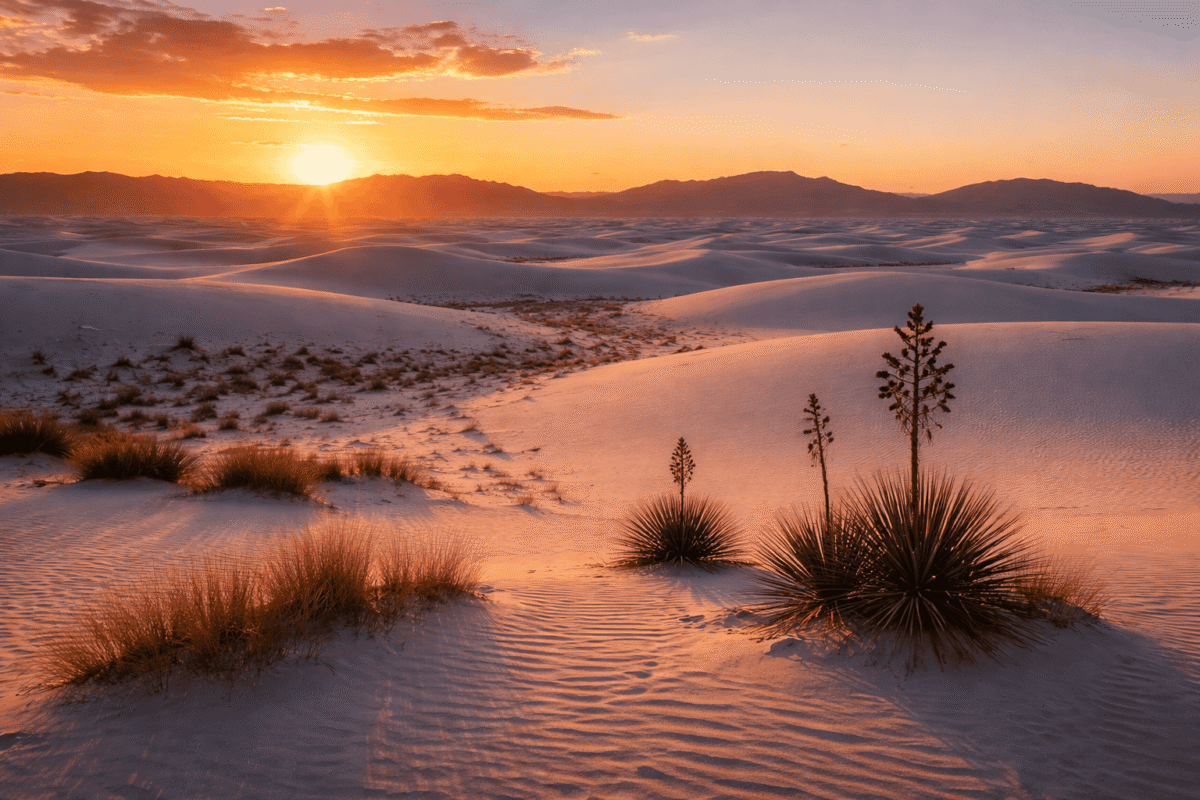
An hour before sunset the basin turns a warm amber that makes the dunes look carved from stone.
For American and Canadian visitors building a Southwest road trip, and for German travelers who tend to prioritize less crowded destinations over famous ones, White Sands is one of the more quietly spectacular parks in the system.
Why White Sands is unique
The reason the dunes are white comes down to one geological detail. Most sand on earth is silica, the same base material as ordinary glass. Gypsum, a calcium sulfate mineral, is water-soluble, which means it almost never accumulates into dunes.
Rain dissolves it and carries it away before it can build. The Tularosa Basin is different because it has no drainage to the sea.
Water that enters the basin stays, and as it evaporates over thousands of years it leaves gypsum crystals behind.
Wind grinds those crystals down into the fine white sand that covers the dunefield today.
The practical effect is a dunefield that behaves differently from anything in Utah or Arizona. Gypsum does not retain heat the way silica does, which means the sand stays cool underfoot even in July and August.
You can walk barefoot in the middle of summer without burning your feet.
The dunes also support a surprising range of adapted plants and animals, including species found nowhere else on earth, which adds a layer of ecological interest the landscape does not immediately advertise.
Things To Do in the park
The main road through White Sands is Dunes Drive, an eight-mile paved loop that ends at a turnaround deep in the dunefield. Most of the named trails branch off this road.
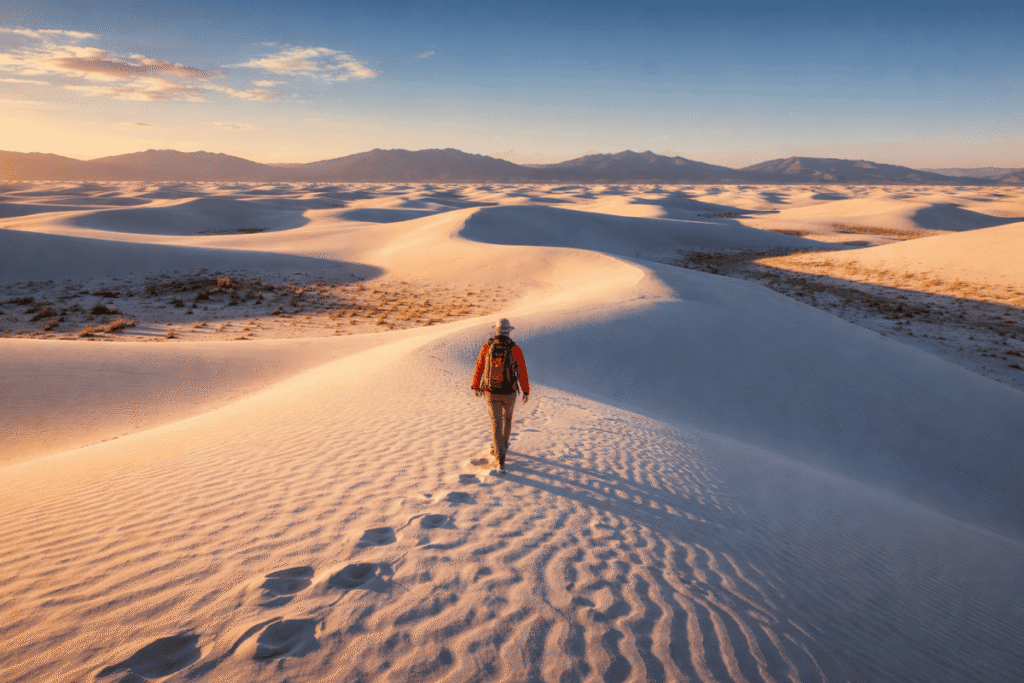
The Alkali Flat Trail is the most demanding, running five miles round trip across open dunes with no shade and minimal trail markers.
Navigation relies on orange poles staked into the sand, and the terrain looks nearly identical in every direction after the first mile.
It is not a trail to take without a full water supply and a realistic sense of the conditions.
The Interdune Boardwalk is the other end of the range. It is a quarter-mile paved loop, fully accessible, running through the lower areas between dune crests where soaptree yucca and other desert plants take hold.
The plants here have developed unusual elongated root systems to keep pace as the dunes bury and shift around them over decades.
It is a short walk and a genuinely interesting one.
Sand sledding is permitted and actively encouraged by the park service. The visitor center sells plastic sleds for around ten dollars.
Families plan trips around this. The sleds go quickly in spring and summer, so arriving early in the day is the practical approach.
Backcountry camping by permit is available for a small number of walk-in sites, and sleeping in the dunes after dark, under a sky with almost no light pollution, is one of the more unusual overnight options in the national park system.
Know this Before You Go
White Sands sits adjacent to White Sands Missile Range, and the military closes Highway 70 and the park entrance for missile testing several times a year, typically for two to three hours per closure.
There is no fixed schedule and no reliable way to predict when a closure will occur.
Visitors on a tight itinerary should check the NPS alerts page for White Sands in the days before arrival.
Road conditions and closure schedules in this part of New Mexico are genuinely variable in a way that can derail a day of travel if you are not paying attention.
The park is open every day of the year except Thanksgiving and Christmas, and hours vary by season.
Trip Planning
One full day is enough to cover the main trails and get a real sense of the dunefield.
Two days opens up the backcountry camping option and gives you the chance to experience both the early morning light and the sunset in the same trip, which are different enough experiences to be worth treating separately.
The $25 vehicle pass covers seven days. The America the Beautiful annual pass at $80 covers all federal recreation lands for a year and pays for itself quickly for anyone visiting more than two or three parks.
If you are routing through the Southwest and have already planned time in Utah, the posts on Zion National Park and Bryce Canyon National Park cover those parks in full and can help you sequence the drive between them and White Sands logically.
Travelers coming from Texas sometimes pair White Sands with Guadalupe Mountains National Park, about 80 miles to the east, and Carlsbad Caverns another 40 miles beyond that.
The three parks together make a reasonable four or five day itinerary.
If you are still mapping out a broader Southwest route, the national park map by state on Tadexprof is a useful reference for visualizing which parks cluster together and what the driving distances actually look like before you commit to a sequence.
Best Time to Visit
Summer temperatures in the Tularosa Basin average around 97 degrees Fahrenheit during the day.
The park service recommends a gallon of water per person for any hike, and the advice is serious rather than precautionary.
The dunefield has very little shade. The practical windows for hiking in summer are before 10 in the morning and the two hours before sunset.
Spring from late March through May is when the conditions are most reliably good. Fall runs close behind.
Winter thins the crowds considerably and brings the occasional snowfall, which does something genuinely strange to a white dunefield and produces a landscape that has almost no visual equivalent anywhere in the park system.
Most visitors to this part of New Mexico treat White Sands as a half-day stop between Albuquerque and El Paso.
The dunefield disagrees with that framing. You either walk far enough into it to lose the parking lot behind the first ridge and understand what you are looking at, or you leave having seen a photograph from ground level.
The park rewards the extra hour. It tends to reward the extra day even more.