Camping at Yosemite National Park is the most sought-after in the entire United States national park system, and the competition for them is not casual. Reservations open months in advance and disappear within minutes.
First-come, first-served options during peak season simply do not exist. If the plan is to show up at a Yosemite Valley campground in July without a reservation and hope something is available, that plan will fail.
Understanding how the system works, when to book, which campgrounds suit which kinds of trips, and what happens when the reservation window closes without a booking is the difference between sleeping under the Sierra Nevada sky and driving back to a hotel in Fresno at 9 p.m.
The honest starting point is this. Yosemite has around a dozen campgrounds spread across the park, ranging from the valley floor to the high country at Tuolumne Meadows.
They serve tent campers, RV travelers, groups, and equestrians. Most require advance reservations from approximately April through October. Outside of that window, a handful operate on a first-come, first-served basis, but even those fill quickly on weekends.
The reservation system is the central fact around which all Yosemite camping planning orbits.
The Valley Campgrounds
The three main campgrounds on the valley floor, Upper Pines, Lower Pines, and North Pines, sit along the Merced River in the eastern end of the valley. Their location is their primary advantage.
Trailheads, shuttle stops, visitor services, and the valley’s defining views are all within easy reach.
For a first visit to Yosemite, waking up in the valley with Half Dome visible above the tree line before the day crowds arrive is an experience that staying outside the park cannot replicate.
Upper Pines is the largest of the three, open year-round, and the only valley campground with a dump station for RV travelers.
Lower Pines and North Pines operate spring through fall. All three are heavily reserved and require planning well in advance.
The NPS releases reservations in rolling windows, and checking the Recreation.gov Yosemite reservation page regularly around the release dates gives the best realistic chance of securing a site.
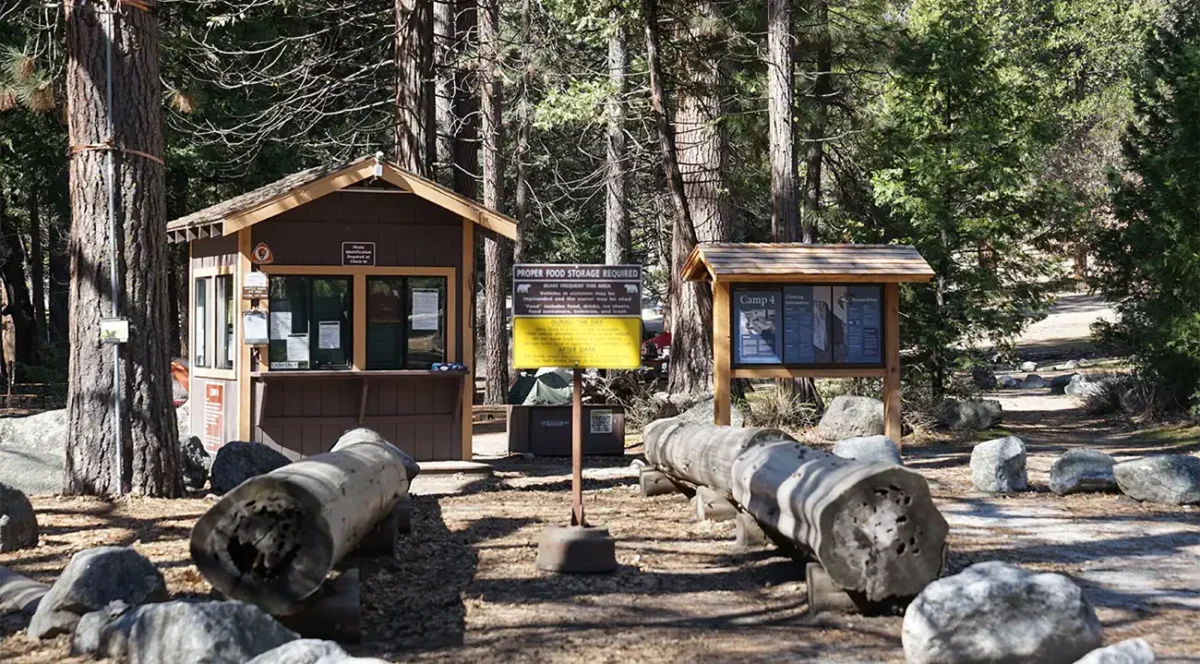
Camp 4 is the valley’s walk-in campground and carries a particular place in outdoor culture as the historic base camp of Yosemite’s climbing community.
Sites there are shared among strangers when demand exceeds supply, which is most of the time.
It is not for every traveler, but for solo visitors or pairs willing to share space, it offers valley access at a lower cost and with a different social texture from the standard campground experience.
Beyond the Valley
Hodgdon Meadow sits near the Big Oak Flat entrance on the park’s western boundary, open year-round, and serves as a useful base for visitors approaching from the north or San Francisco.
It is less scenically dramatic than the valley campgrounds but considerably easier to book, and the surrounding forest has its own quieter appeal.
Crane Flat, nearby, is a summer-only option at higher elevation that offers cooler temperatures than the valley floor during July and August.
Wawona Campground in the park’s southern section operates near the Mariposa Grove of giant sequoias, the largest grove of these trees in the park.
For families or visitors whose primary interest is the sequoias rather than the valley’s granite formations, Wawona positions a trip differently from the valley campgrounds and with notably less booking competition.
Bridalveil Creek Campground, accessible via Glacier Point Road, sits at 7,200 feet and operates during summer only.
The elevation brings cooler temperatures and a high-country feel while remaining accessible by passenger vehicle. For visitors who have already done the valley and want a different experience of the park, it is worth the extra planning.
Tuolumne Meadows Campground is the high-country option, sitting at 8,600 feet along the Tioga Road corridor that connects Yosemite to the eastern Sierra.
It is open only during summer, dependent on Tioga Road being clear of snow, and offers access to some of the finest subalpine hiking in California.
German visitors in particular, who often come with strong mountain hiking backgrounds, tend to find Tuolumne a more rewarding home base than the valley for a hiking-focused trip.
The tradeoff is that Tioga Road closes for the season in fall and does not reopen until late May or June, sometimes later.
Anyone building an itinerary around Tuolumne should verify road status through the NPS current conditions page before committing to dates.
Campfire Rules
Food storage in Yosemite is not advisory. Every campground in the park operates under strict bear canister or bear box requirements.
All food, scented items, and anything a bear might investigate must be stored in the metal food storage boxes provided at each site, or in an approved hard-sided container.
Leaving food in a tent or in a car, even a locked one, is a violation of park regulations and a genuine risk to both the camper and the bear involved.
Campfires are allowed in fire rings and only when attended, but in Yosemite Valley campgrounds and Hodgdon Meadow they are restricted to between 5 p.m. and 10 p.m. This is not a minor administrative rule.
The valley floor sits in a bowl shape that traps particulate matter from campfires near the ground at night and in early morning, and air quality in the campgrounds on still evenings can be meaningfully degraded by fire smoke.
Considering skipping the fire entirely, or keeping it brief, is genuinely good practice for everyone camping nearby.
Reservations
For visitors who missed the reservation window, the options narrow but do not disappear entirely.
Some campgrounds release a portion of their sites on a two-week advance rolling basis from around July through mid-October, which means checking back regularly in the weeks before a trip can sometimes yield availability.
First-come, first-served camping exists in late fall, winter, and early spring, but those sites fill on weekends and should not be assumed available without an early arrival.
The more reliable fallback is gateway accommodation outside the park.
For travelers weighing that decision, the best hotels near Yosemite guide covers options in Mariposa, El Portal, and Groveland across different budget ranges, including properties that work well as a base for day trips into the valley when a campsite is not in the cards.
The Campsite
The campgrounds in Yosemite are functional, well-run, and in several cases genuinely beautiful. But they are means rather than ends.
The campsite’s value is measured by what it makes possible the next morning, which trail is reachable, how early you can be on the water or on the rock, what the light looks like over Half Dome at 6 a.m. when almost no one else is moving yet.
Securing that experience requires treating the reservation the same way any seasoned traveler treats a flight booking for peak season.
The earlier the better, with no assumption that something will be available if you wait.