Where is great smoky mountains national park?
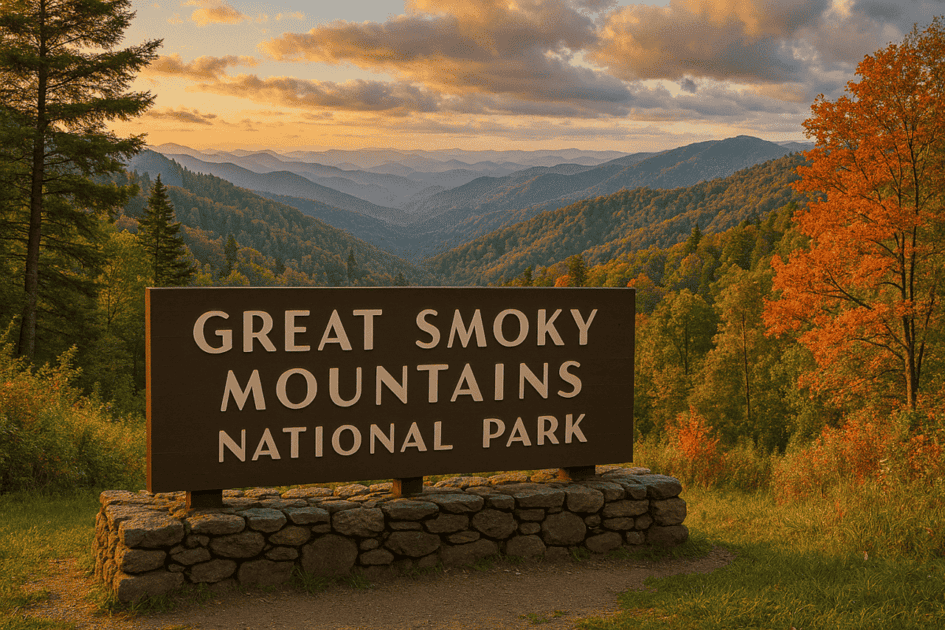
Great Smoky Mountains National Park straddles the border between North Carolina and Tennessee in the southern Appalachian Mountains, covering just over 522,000 acres of ancient forest, mountain ridges, and river valleys.
The main Tennessee entrance is through Gatlinburg, about 35 miles southeast of Knoxville. On the North Carolina side, the primary entrance runs through Cherokee, about 55 miles west of Asheville.
The closest major airports are McGhee Tyson in Knoxville, roughly an hour from the Gatlinburg entrance, and Asheville Regional on the North Carolina side.
Is great smoky mountains national park free to enter?
Yes. Great Smoky Mountains National Park charges no entrance fee, making it one of the very few national parks in the United States where admission is free to all visitors.
However, since March 2023, a parking tag is required if you plan to park for more than 15 minutes anywhere in the park. A daily parking tag costs $5, a weekly tag costs $15, and an annual tag runs $40.
Tags are not transferable or refundable. Purchase yours in advance at recreation.gov before you leave home, print it, and display it on your dashboard. Attempting to sort this at a busy trailhead with no cell signal is the most common avoidable frustration first-time visitors encounter.
Why it’s the most visited national park in America?
The answer is not a single thing. It is the combination of free entry, easy road access, extraordinary biodiversity, year-round accessibility, and a cultural heritage that runs deeper than most visitors realize.
The park is world renowned for its diversity of plant and animal life, containing more tree species than all of northern Europe combined, over 1,500 species of flowering plants, and one of the highest densities of black bears in the eastern United States.
The ancient mountains themselves, among the oldest on the planet at roughly 300 million years, carry a quality of stillness that is hard to articulate and easy to feel the moment you arrive.
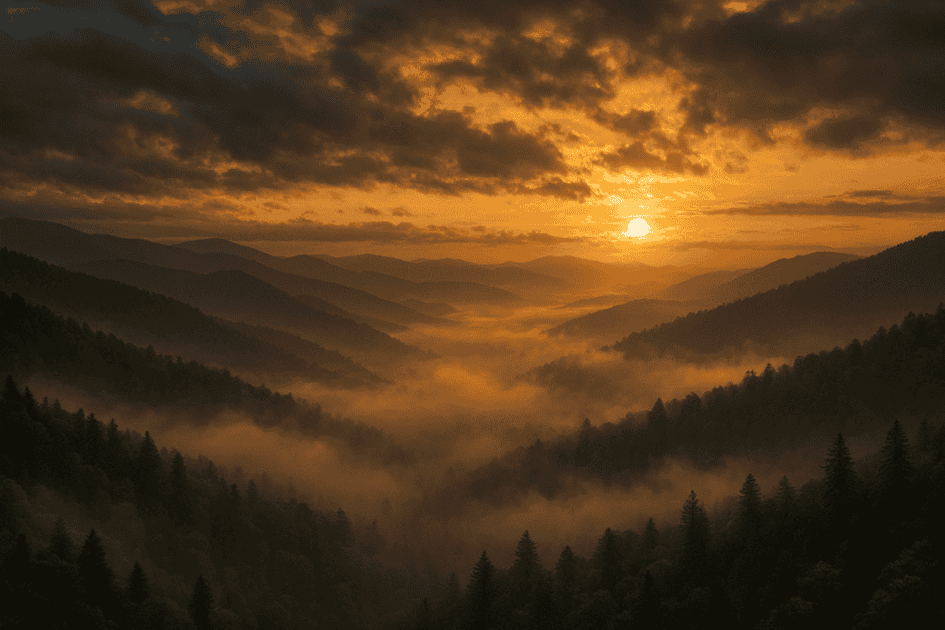
The mist that gives the mountains their name is produced by the trees themselves, releasing water vapor that catches the light at dawn and makes the ridge lines look like they are breathing.
Things to Do in Great Smoky Mountains
Cades cove
Cades Cove is an 11-mile one-way loop road through an isolated valley on the Tennessee side of the park and is consistently among the most visited destinations in any national park in the country.
The loop circles an open valley surrounded by forest and mountain ridges, passing preserved 19th-century log cabins, working grist mills, churches, and cemeteries that tell the story of the Appalachian settlers who lived here before the park was established.
Wildlife density in Cades Cove is exceptional. White-tailed deer, black bears, wild turkeys, coyotes, and groundhogs are all regularly spotted from the road.
The loop can take anywhere from 45 minutes to several hours depending on stops and traffic. Arrive before 9 a.m. on weekends during summer and fall or you will spend more time in a slow-moving line of vehicles than in the valley itself.
Kuwohi and newfound gap road
The highest peak in the park was officially restored to its Cherokee name Kuwohi in 2024, replacing the colonial-era name Clingmans Dome. At 6,643 feet it is the highest point in the Appalachian Mountains and one of the highest peaks east of the Mississippi.
A seven-mile spur road off Newfound Gap Road leads to a parking area from which a steep half-mile paved trail climbs to a concrete observation tower at the summit. On clear days the views extend over 100 miles across multiple states.
The spur road closes from December through late March. Newfound Gap Road itself, US Highway 441, connects the Cherokee entrance in North Carolina to Gatlinburg in Tennessee through the heart of the park, climbing from around 2,000 feet at the valley floors to 5,048 feet at Newfound Gap.
It is one of the finest scenic drives in the eastern United States and passes numerous overlooks and trailheads along its 31-mile route.
Cataloochee valley and elk viewing
Cataloochee Valley on the North Carolina side of the park is the best place in the entire park to observe elk and one of the most rewarding destinations in any eastern national park.
The elk herd, reintroduced starting in 2001, now numbers over 200 animals and is most visible at dawn and dusk in the valley meadows.
Reaching Cataloochee requires driving a narrow gravel road through dense forest, which keeps the crowds smaller than anything you will find on the Tennessee side.
The valley itself opens dramatically after the tree line to reveal wide mountain meadows surrounded by ridges, historic homesteads, a one-room schoolhouse, and a white wooden church.
Volunteer naturalists are typically present during peak elk viewing hours to share information about the herd and the valley’s history.
Hiking and waterfalls
The park contains over 800 miles of trails ranging from flat riverside walks to demanding backcountry routes.
The Alum Cave Trail is one of the most popular in the park, covering five miles round trip to Alum Cave Bluffs with dramatic overhanging rock formations and strong views toward the summit of Kuwohi.
For waterfalls, Rainbow Falls drops 80 feet and is the tallest single-drop waterfall in the park, accessible on a 5.4-mile round trip trail from the Roaring Fork Motor Nature Trail.
Abrams Falls is shorter and drops into a wide turquoise pool that draws swimmers in summer. Note that the popular Laurel Falls Trail remains closed through summer 2026 for rehabilitation.
Synchronous fireflies
Each year in late May and early June, a species of firefly in the park called Photinus carolinus produces synchronized light displays where thousands of fireflies flash in unison across the dark forest floor.
It is one of only a few places in the world where this phenomenon can be observed, and the park manages access through a ticketed shuttle system from Sugarlands Visitor Center to limit impact on the habitat.
Tickets are distributed through a lottery on recreation.gov several months before the event and are highly competitive. If this experience is on your list, begin watching for the lottery opening date in early spring.
Best Time to Visit
Spring from late March through May brings wildflower blooms that earn the park its unofficial nickname as the Wildflower National Park.
Over 1,500 species flower across the park from late winter through early summer, and the annual Spring Wildflower Pilgrimage in late April draws botanists and photographers from across the country.
Fall from mid-September through October is the most visually spectacular season, with the ridge lines turning in waves of gold, orange, and red as the color moves down from the high elevations toward the valley floors.
It is also the most competitive season for accommodation and the most congested on the roads. Summer is fully operational but heavily crowded. Winter is quiet, genuinely beautiful, and the best season for anyone who values solitude over convenience.
For current trail conditions, road closures, and any active alerts before your visit, always check the official Great Smoky Mountains conditions page directly. Conditions in the park change quickly and the NPS updates this page regularly.
Nearby destinations
Great Smoky Mountains sits within reasonable driving distance of several other significant destinations. Asheville, North Carolina, about an hour from the Cherokee entrance, is one of the most interesting mid-sized cities in the American South with a strong food and arts scene worth a full day or two.
For visitors building a longer eastern United States itinerary, the park also connects naturally to the Blue Ridge Parkway, which runs northeast from Cherokee through Appalachian Virginia.
If your trip extends further into the American West or you are planning a broader national parks circuit, our guides to Zion National Park, Bryce Canyon National Park, and the Grand Canyon give you the same depth of planning detail for each of those destinations.
The Great Smoky Mountains do not announce themselves. They settle over you gradually, through the mist on the ridgelines in the morning, the silence of an old-growth forest in the rain, the sound of a creek running fast beneath a trail you are sharing with no one.
Give the park more time than you think you need. It rewards patience more than most places on earth.