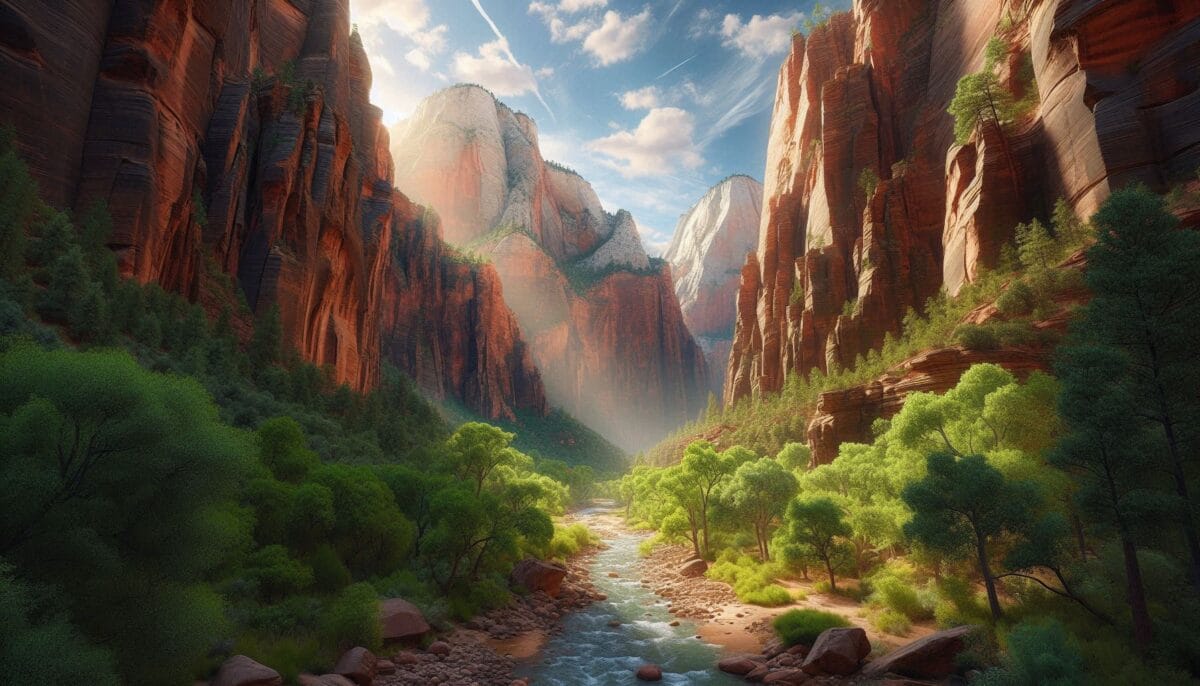
There are national parks that are beautiful. Then there is Zion national park.
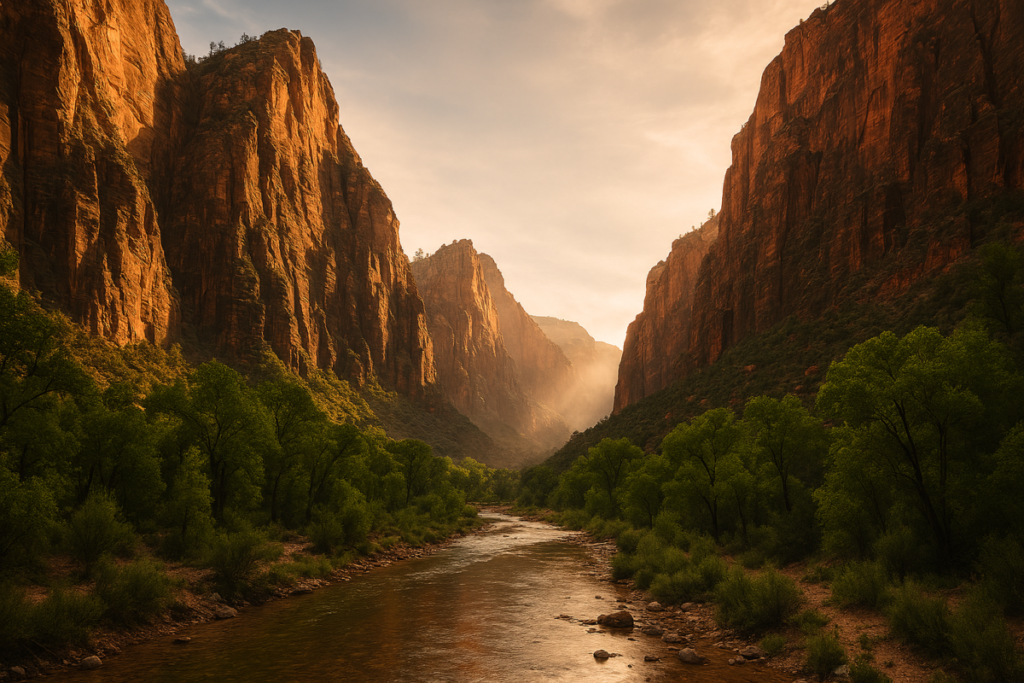
The difference is hard to explain until you are standing at the bottom of a 2,000-foot sandstone cliff watching the light shift from orange to red to a color that has no real name, and you realize you have been standing there for twenty minutes without checking your phone.
That is what Zion does to people. It is the kind of place that resets something in you.
Located in southwestern Utah, Zion National Park sits at a rare geographic crossroads where three major ecosystems meet: the Mojave Desert, the Colorado Plateau, and the Great Basin.
That convergence produces a landscape unlike anything else in North America. The canyon walls tower above narrow trails. The Virgin River carves its way through slot canyons barely wide enough for a single hiker.
Cottonwood trees line the canyon floor in gold every fall. And at night, without any significant light pollution for miles, the sky above the park is the kind of dark that makes you feel small in the best possible way.
It draws over four million visitors every year, making it consistently one of the most visited national parks in the United States. Americans drive from across the country.
Canadians build entire southwestern road trips around it.
German travelers, who represent one of the largest international visitor groups in Utah’s national parks, put it at the top of their American itinerary more often than any other single destination in the West. The question is not whether it is worth the trip.
The question is how to do it well.
How Do You Get to Zion National Park?
The nearest major airport is Las Vegas Harry Reid International, about two and a half hours southwest of the park. Salt Lake City International is roughly four hours north and makes more sense if you are combining Zion with Bryce Canyon, Capitol Reef, or Arches on a longer Utah loop.
From Los Angeles, it is a five-hour drive through the Mojave that is genuinely enjoyable if you are not rushing it.
Rental cars are essentially non-negotiable. There is no meaningful public transportation connecting major cities to the park, and while the park operates its own free shuttle system inside the main canyon, you need a vehicle to get there from anywhere outside of Springdale, the gateway town that sits directly at the south entrance.
Springdale itself is worth knowing about before you arrive. It is a small, well-curated town that manages to offer genuinely good food, quality lodging, art galleries, and outdoor gear shops within walking distance of the park entrance.
Staying in Springdale puts you inside the shuttle system, which means you can leave your car at your hotel and move through the canyon entirely on foot and by bus.
For visitors arriving from Germany or Canada who are not accustomed to car-centric American travel, Springdale makes Zion considerably more accessible than most western parks.
Entry Fee: Zion National Park
The standard vehicle entrance fee is $35, valid for seven consecutive days. Individual entrance on foot or by bicycle is $20 per person.
The America the Beautiful annual interagency pass covers entrance fees at all federal lands including Zion for $80, which pays for itself quickly if you are visiting more than two parks on a single trip.
Two of the park’s signature experiences require separate reservations beyond the entrance fee. Angels Landing requires a permit obtained through a lottery system, with a seasonal lottery open in the months leading up to the visit and a day-before lottery for last-minute opportunities.
The Narrows does not currently require a permit for day hiking from the bottom up, but the top-down route requires a permit arranged through
Two of the park’s most iconic hikes, Angels Landing and the top-down Narrows route, require advance permits through the National Park Service reservation system. Both book out fast. Plan months ahead if these are your priorities, not weeks.
All three campgrounds inside the park, Watchman Campground, South Campground, and Lava Point Campground, require reservations made well in advance through recreation.gov. Walk-up sites at popular times of year are essentially nonexistent.
Best Things to Do
Angels Landing
This is the hike that most people picture when they think of Zion, and it earns its reputation. The trail climbs 1,488 feet over 5.4 miles round trip, finishing with a half-mile stretch along a narrow sandstone fin with sheer drop-offs on both sides and chains bolted into the rock to assist the ascent.
The views from the summit are panoramic in every direction over the canyon. It is physically demanding, genuinely exposed in places, and not suitable for anyone with a significant fear of heights. It is also one of the most rewarding hikes in the American West.
The Narrows
The Narrows is a slot canyon hike through the Virgin River itself. You are not hiking beside water. You are hiking in it, wading through knee-to-waist-deep current along a canyon corridor where the walls rise 1,000 feet above you and narrow to as little as 20 feet across.
The bottom-up route starts at the Temple of Sinawava at the end of the main canyon road and covers about 16 miles round trip to the full slot canyon experience, though most day hikers turn around well before that. Waterproof boots, dry bags, and trekking poles are not optional.
Renting the right gear from outfitters in Springdale before you start is standard practice and worth the $40 to $50 it costs.
Canyoneering and Climbing
Zion has some of the most technically demanding and scenically spectacular canyoneering routes in the world. The Subway, a slot canyon route in the Kolob Canyons section of the park, is one of the most photographed canyoneering destinations in Utah.
Technical routes like Mystery Canyon and Keyhole Canyon require ropes, wetsuits in some seasons, and genuine experience or a qualified guide.
If you are new to canyoneering, guided tours through operators based in Springdale offer half-day and full-day experiences that take the technical burden off you while still delivering the full canyon experience.
Dark Sky Stargazing
Zion is a Dark Sky Certified park, which puts it in rare company globally. On a clear night away from the canyon floor, the Milky Way is visible to the naked eye and the density of stars overhead is disorienting in the best way.
The best stargazing inside the park is from the Kolob Terrace Road area or from higher elevation pullouts along the Zion-Mount Carmel Highway. Spring and fall offer the clearest skies.
Cycling
The canyon road that runs from the visitor center to the Temple of Sinawava is shared between the shuttle buses and cyclists, and riding it is one of the more underrated ways to experience the canyon.
You move at your own pace, you can stop anywhere, and the scale of the walls around you becomes more visceral on a bike than in a vehicle. Bike rentals are available in Springdale.
The road is paved and relatively flat compared to surrounding trails, making it accessible for most fitness levels.
Best Time to Visit
Spring from March through May is the most consistently rewarding time to visit.
Temperatures in the canyon sit between 60 and 80 degrees Fahrenheit during the day, wildflowers are blooming across the lower canyon, and the Virgin River is running fast from snowmelt, which makes The Narrows more dynamic and the canyon more lush.
Crowds are building but have not reached their summer peak.
Summer from June through August is the busiest period and also the hottest, with canyon floor temperatures regularly exceeding 100 degrees Fahrenheit. Flash flooding risk in The Narrows is highest during summer monsoon season, typically from July through September.
The park is still worth visiting in summer, but you need earlier start times, more water, and genuine awareness of weather conditions.
Fall from September through November is when many experienced visitors prefer the park. The cottonwood trees along the canyon floor turn bright yellow and gold, temperatures moderate back into the ideal range, and crowds begin to thin after Labor Day.
October is particularly stunning and still draws significant visitor numbers, so reservations for accommodation and permits remain competitive.
Winter from December through February is the quietest time and one of the most striking visually. Some trails become icy and certain roads close, but Angels Landing and the Narrows remain accessible for properly equipped hikers.
For current conditions including flash flood watches, road closures, and trail status, check the National Park Service Zion conditions page before any planned activity.
Observations and Notes
Cell service inside the canyon is limited. Download offline maps and trail information through AllTrails or the NPS app before you arrive. Hydration is genuinely serious business in summer; rangers recommend a minimum of one liter of water per hour of activity in hot conditions.
The park does not allow personal vehicles on the main canyon road between April and November during shuttle operating hours, so plan buffer time during peak morning hours when lines build at the visitor center stop.
Dogs are allowed in picnic areas and along roads on a leash, but are not permitted on park trails. Weather changes dramatically with elevation, and afternoon thunderstorms build quickly over the higher ridges in summer without much warning. Dress in layers regardless of the forecast at lower elevation.
If the Utah national parks circuit is part of a longer American trip, Zion pairs naturally with Bryce Canyon two hours northeast and the Grand Canyon’s North Rim two and a half hours south. Our guide to planning a southwest national parks road trip covers the full circuit with practical notes on route order, drive times, and where to stay between parks.
If you are still deciding between Utah’s major parks for a shorter trip, our post on Zion vs Bryce Canyon: which park should you visit first breaks down the honest differences so you can prioritize based on what you actually want from the experience.
Zion will ask something of you. The elevation, the heat, the exposure on the taller trails. It is not a passive experience. What it gives back in return is the kind of clarity that is difficult to find anywhere else. Go prepared, go early, and give it more than a single day. The canyon rewards the people who stay.