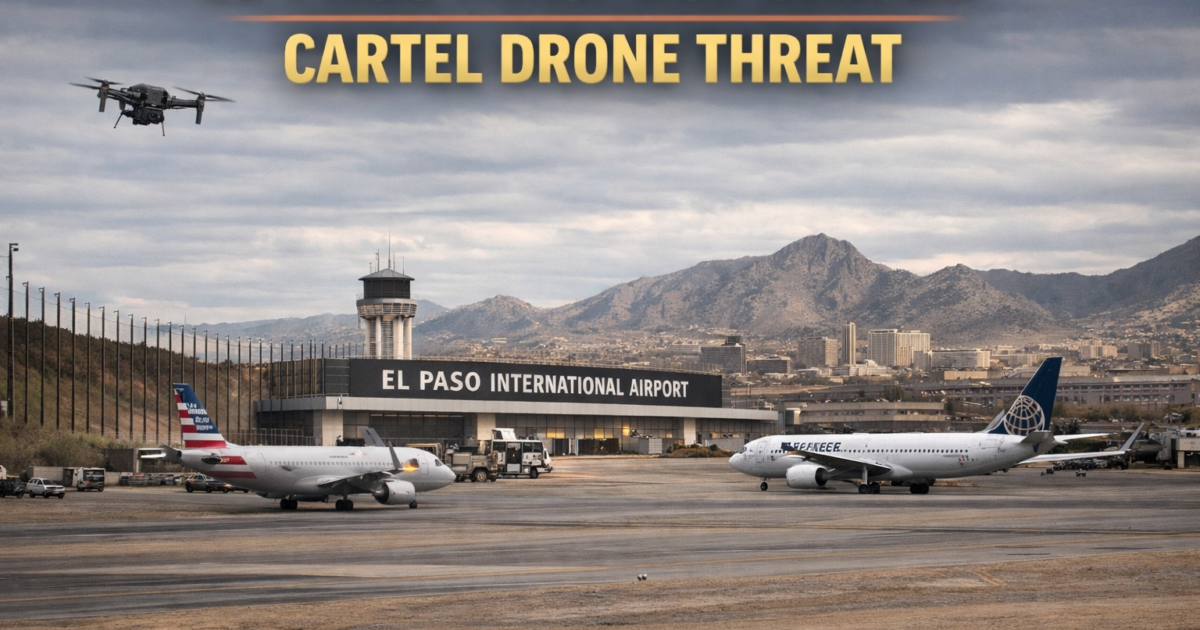
El Paso airspace, Texas was abruptly closed by the Federal Aviation Administration (FAA), grounding all flights in and out of El Paso International Airport for hours.
This post is a gathered information from public information on the internet. Here is a break down of what actually happened.
The sudden and confusing move sparked widespread disruption, political controversy, and intense scrutiny of national security policies along the U.S.–Mexico border.
The closure was initially linked to a Mexican cartel drone incursion by the Trump administration, but conflicting accounts and deeper context have raised questions about how and why the decision was made and what it means for border security and civil aviation.
Read Also: Golden Globe Awards 2026: see full list of nominees
What Happened in El Paso
Late on February 10, the FAA issued a notice imposing a Temporary Flight Restriction (TFR) over El Paso International Airport and surrounding airspace, citing “special security reasons.”
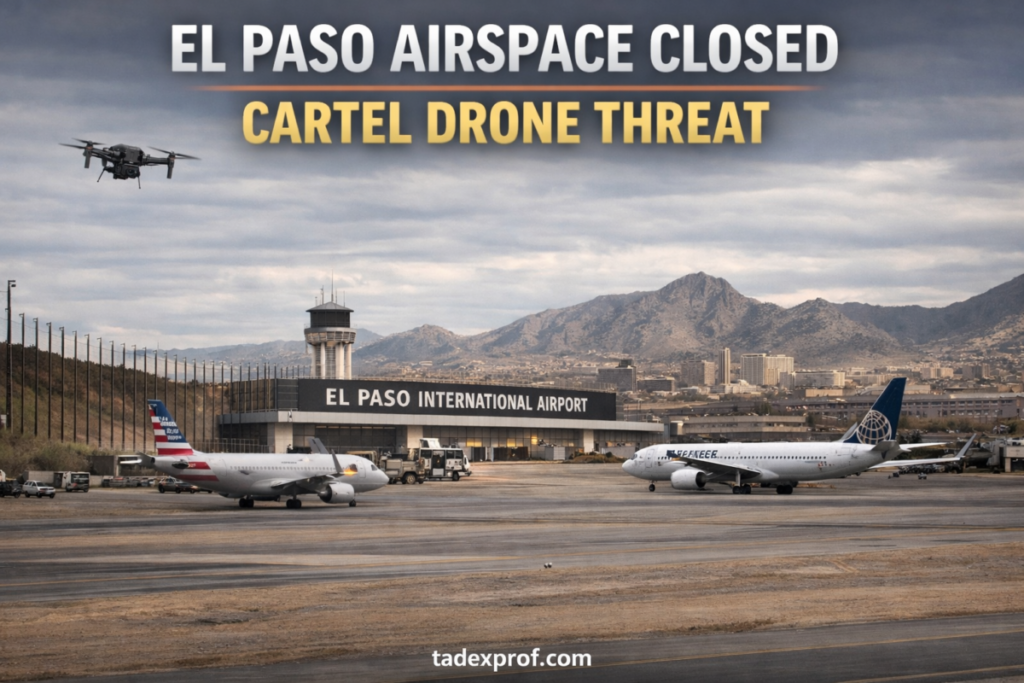
The restriction was unusual in scope, covering a ten‑mile radius up to 18,000 feet and was initially supposed to last until February 20. All civilian flights, including commercial, cargo, general aviation, and even medical flights, were grounded with only a few hours’ notice.
Within about eight hours, the FAA withdrew the restriction and announced that flights would resume as normal, stating that “there is no threat to commercial aviation.”
Transportation Secretary Sean Duffy described the situation on social media as a response to a cartel drone incursion that had been “neutralized,” but the rapid reversal left many observers and local officials puzzled.
Conflicting Accounts and Confusion
The official narrative offered by the Trump administration and U.S. Transportation Secretary suggested that drones operated by Mexican cartels had entered U.S. airspace near El Paso, prompting a defensive response.
Cartels have increasingly used unmanned aircraft for surveillance and drug smuggling along the U.S.–Mexico border. According to security officials, more than 1,000 drone incursions occur monthly, though most have been non‑violent and focused on logistics rather than attacks.
Yet unnamed government and aviation sources told Reuters that the FAA’s decision to shut down the airspace was driven not by actual drone threats but by concerns over military testing of counter‑drone technology near Fort Bliss, a U.S. Army installation close to El Paso.
This technology includes high‑energy laser systems designed to disable or destroy unmanned aircraft. Aviation specialists noted that a typical drone sighting near an airport would lead to a short pause in operations, not an extended closure of this magnitude.
Local and Political Reactions
Local officials and lawmakers expressed deep frustration at the lack of communication and the chaotic nature of the shutdown. El Paso Mayor Renard Johnson criticized the FAA for failing to coordinate with city leaders, hospitals, and airport authorities before grounding flights.
He said that restricting airspace over a major city without advance notice was unacceptable and put public safety at risk.
Representative Veronica Escobar, whose congressional district includes El Paso, also challenged the government’s explanation.
Escobar noted that drone incursions along the border have occurred for years and stressed that “there is no threat… which is why the FAA lifted this restriction so quickly.” Her remarks underscored the disconnect between federal agencies and local stakeholders during the incident.
International Response
The Mexican government, for its part, denied having any information about a drone incursion and called for cooperation and transparency from U.S. authorities.
President Claudia Sheinbaum stated that there was no confirmed information about drones flying at the border and emphasized that Mexican airspace had remained open during the U.S. closure. These remarks highlighted diplomatic sensitivities as both countries navigate complex border security issues.
The Role of Counter‑Drone Technology
A significant point of contention in public reporting centers on the use of laser‑based counter‑drone systems by U.S. forces and border security agencies.
Some reports suggested that Customs and Border Protection (CBP) deployed a laser on loan from the Pentagon in what may have been a test of anti‑drone measures.
In one account, this system targeted what was initially thought to be a cartel drone but later identified as a simple party balloon. This misidentification, along with a lack of coordination between the Department of Defense, DHS, and the FAA, may have contributed to the dramatic decision to halt flights.
The incident highlighted the challenges of integrating advanced military technology into civilian airspace without compromising safety or communication protocols. High‑energy lasers pose particular risks to aviation if not properly coordinated due to potential hazards to pilots and aircraft systems.
Broader Security and Policy Implications
The El Paso airspace closure incident has broader implications for U.S. border security policy, especially under the Trump administration’s focus on curbing cartel activities and drone smuggling operations.
While drones have become a growing tool for criminal networks, experts caution that including military rhetoric or actions could escalate tensions without clear evidence of direct threats to U.S. soil.
Critics argue that the use of ambiguous national security language to justify dramatic actions like shutting down an international airport undermines public trust and highlights fractures in government coordination.
Lawmakers have called for clearer protocols, better interagency communication, and transparent explanations for decisions that impact public safety and major infrastructure.
What This Means for Travelers and Residents
For residents of El Paso and travelers, the sudden closure was a stark reminder of how national security decisions can ripple into everyday life. Thousands of passengers were affected, with flights canceled, diverted, or delayed.
Medical flights and emergency services also faced disruptions during the brief restriction, exposing vulnerabilities in aviation contingency planning.
El Paso International Airport, a vital transportation hub for western Texas and neighboring New Mexico, serves millions of passengers annually and supports cross‑border commerce with Ciudad Juárez, Mexico.
A sudden shutdown of this scale has not been seen since the aftermath of the September 11, 2001 attacks, making this a rare and impactful event in modern aviation history.
Conclusion
The El Paso airspace closure on February 11, 2026 was a dramatic and unprecedented event that exposed multiple fault lines in U.S. national security, aviation safety, and interagency coordination.
What started as a federal alert about cartel drone threats quickly became a complex narrative involving advanced military technology, miscommunication, and political controversy.
For local communities and national observers alike, the episode raises important questions about how governments balance security concerns with transparency and public safety in the age of emerging threats.
As the investigation continues and policymakers consider reforms, one clear lesson stands out: in matters of airspace and border security, clarity, coordination, and communication are essential to prevent confusion and protect the public.
El Paso airspace Closure: Sources
- El Paso airspace closure: NYT
- Cartel drones become flashpoint between US and Mexico – Reuters
- Why was the El Paso airport shut down? What we know – El Paso Times
- Tadexprof – Tourism and Travel – Category
- ‘Unacceptable:’ El Paso mayor slams FAA after airspace shutdown – USAToday