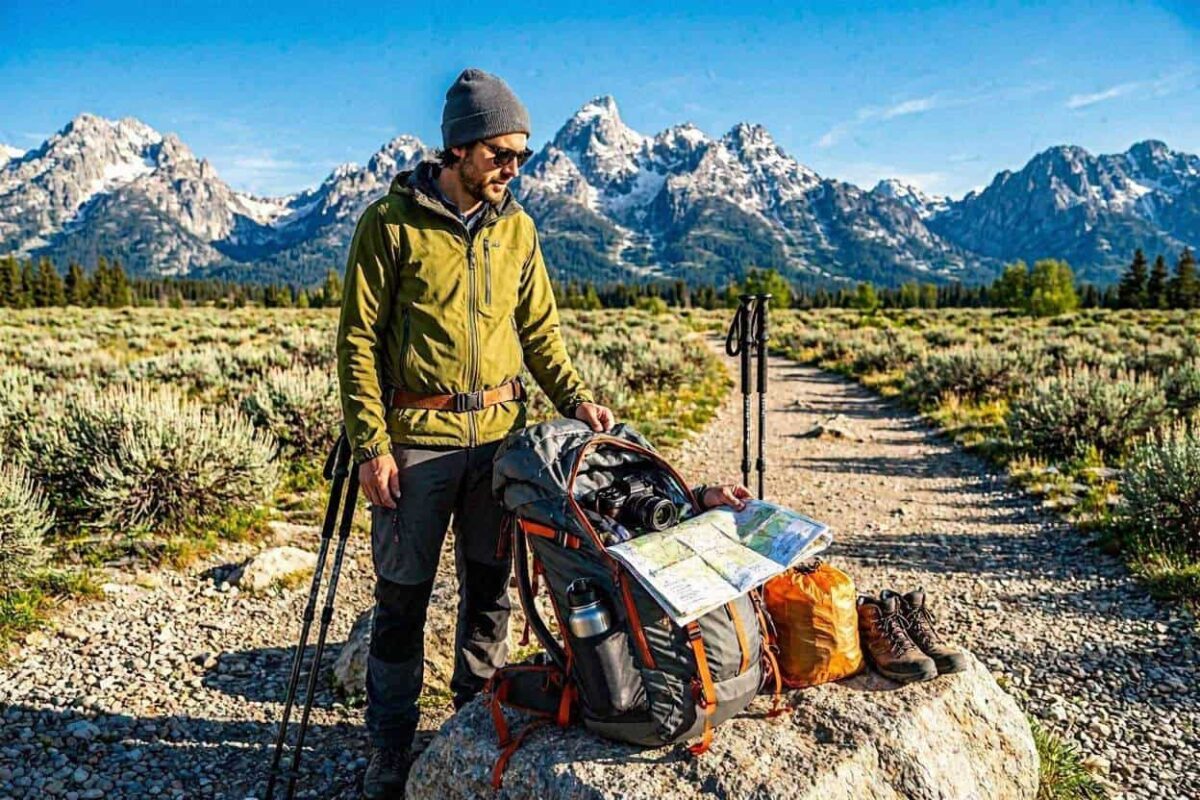
A Grand Teton National Park packing list looks nothing like what you would throw together for a day hike at a state park.
The elevation starts at 6,800 feet on the valley floor, overnight temperatures in summer regularly drop into the mid-30s Fahrenheit even in July, and afternoon thunderstorms are common enough to be a planning assumption rather than a contingency.
A bear canister is required by law in the backcountry, and grizzly bears are an active presence in the ecosystem.
This gear list covers every category you need to address before you leave the trailhead behind, written for travelers who plan to sleep in the wilderness rather than return to a lodge at the end of the day.
The Shelter
Your tent, sleeping bag, and sleeping pad are the foundation of a backcountry trip, and the margin for error in Grand Teton is smaller than in warmer parks.
The sleeping bag needs to be rated for 15 to 29 degrees Fahrenheit at minimum.
The average daily low in the park during summer sits between 35 and 42 degrees at valley elevation, but temperatures drop further at higher camps in the canyons, and wet conditions accelerate heat loss in ways that a summer-rated bag cannot handle safely.
A waterproof stuff sack for the sleeping bag is not optional in a park that sees consistent afternoon rain.
A three-season backpacking tent with guylines and a repair sleeve handles the conditions most backcountry travelers will encounter from June through September.
A tent footprint extends the life of the tent floor against rocky ground and is worth the minimal weight.
Anyone planning to cover high mileage days will benefit from trekking poles both for trail efficiency and for knee support on the steep descents that characterize Grand Teton’s canyon routes.
Clothing
The temperature swing at Grand Teton is the thing that catches first-time backcountry visitors off guard.
A midday high of 78 degrees and a 3 AM low of 36 degrees in the same camp means the clothing system needs to cover both without redundancy.
The layering approach that works consistently here runs from a wicking base layer against the skin, a midweight fleece or insulated jacket as the mid layer, and a waterproof breathable rain jacket as the outer shell.
Fleece pants and a down or synthetic insulated jacket belong in the pack regardless of the forecast.
Nights in the backcountry at altitude reward preparation in a way that mornings in the valley do not.
A warm hat and gloves are not winter items in this context.
They are standard summer backcountry gear for any camp above 8,000 feet.
Rain pants complete the wet weather system and are the piece most frequently left behind by travelers who pay for that decision during the first afternoon storm.
Hiking boots with ankle support are strongly recommended over trail runners for the rockier canyon trails, particularly on the approaches to the high camps.
Sandals serve a real purpose in camp for stream crossings and foot recovery, and camp sandals weigh almost nothing relative to what they contribute to comfort over a multi-day trip.
Gaiters are worth carrying for tick protection in the brushy lower elevation trail sections, particularly in June when vegetation is at its most dense.
Navigation and Safety
Navigation and safety in Grand Teton’s backcountry demand more preparation than most people expect before their first overnight trip.
A bear canister is mandatory for all backcountry camping, and it shapes every food and storage decision from the moment you start packing.
The park loans canisters free of charge at the Craig Thomas Discovery and Visitor Center, Jenny Lake Ranger Station, and Colter Bay Visitor Center, which is a practical option for anyone flying in without one. Any IGBC-approved canister you already own works equally well.
Everything that carries a scent goes inside it every night without exception: food, trash, toiletries, and any scented gear.
Grizzly bear activity in the Tetons is consistent and documented, and the canister requirement exists precisely because it reduces dangerous encounters.
Bear spray is the tool rangers consistently recommend for personal safety in grizzly country, proven more effective than firearms at close range.
Keep it in a hip holster where it is reachable in seconds, not buried under a rain jacket in the main compartment.
For navigation, a topographic map and compass form the baseline, with a GPS unit serving as a supplement rather than a replacement.
Cell service disappears in the canyon backcountry and is unreliable throughout most of the park.
A satellite communicator or personal locator beacon adds an emergency communication layer that earns its weight on any multi-day solo trip.
An LED headlamp with spare batteries, a whistle, and a backcountry first-aid kit calibrated for distance from medical care round out the safety system.
Every item in the pack should serve at least one of the ten essential categories: navigation, sun protection, insulation, illumination, first aid, fire starting, repair tools, nutrition, hydration, and emergency shelter.
A gap in any one of those categories is what creates a serious problem on day two when the weather shifts and the nearest trailhead is eight miles behind you.
Full permit requirements, bear canister regulations, and campsite reservation details are managed through the Grand Teton National Park backcountry permit page on Recreation.gov, which is the only place to secure an overnight wilderness permit before the trip begins.
Essentials
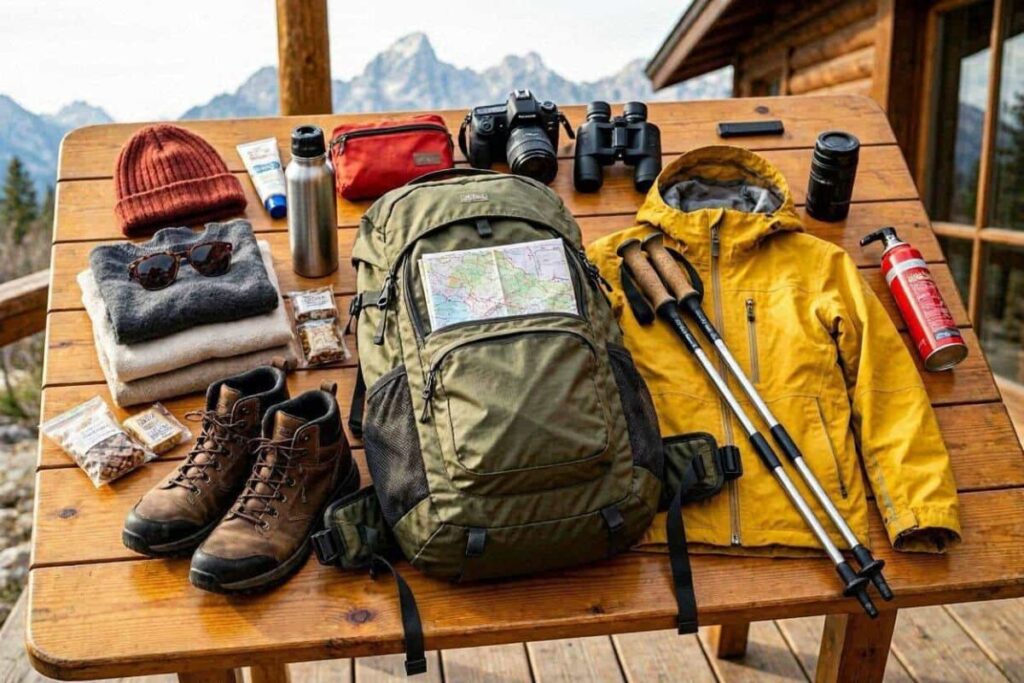
Three water bottles or a hydration reservoir system for carrying at least two to three liters is the baseline.
Water sources in the Tetons are abundant, but all surface water requires treatment before drinking.
A primary filter or purification system and a backup chemical treatment option provides redundancy that matters on longer trips.
Giardia is present in backcountry water sources throughout the park, and symptoms appear days after exposure, which makes treatment non-negotiable.
Food planning for Grand Teton backcountry follows the caloric burn rate of high-elevation hiking, which runs significantly higher than hiking at sea level.
An extra day’s supply of food beyond your planned itinerary is standard practice, providing both a buffer for extended stays due to weather and a safety margin if the trip takes longer than expected.
Freeze-dried meals reduce weight and preparation time in camp, and high-calorie snacks such as nuts, jerky, and energy bars handle the sustained output of long hiking days.
A lightweight stove, fuel canister, and a minimal cook set complete the food system.
Biodegradable soap, a sanitation trowel, and the Leave No Trace principles for human waste apply throughout the backcountry.
The park asks that waste be buried in a cathole at least six inches deep and two hundred feet from water, trails, and campsites.
Waste management is a planning consideration, not an afterthought.
Entry Requirements
A wilderness permit is required for all backcountry overnight camping in Grand Teton.
Permits are available in person at the Craig Thomas Discovery and Visitor Center in Moose or online through the park’s reservation system.
Summer permits for popular areas such as Cascade Canyon and the Paintbrush-Cascade loop book out quickly.
Securing the permit before finalizing any other trip detail is the right sequence.
A valid park pass covers the entrance fee.
For readers building out the full Grand Teton trip around this packing list, the best time to visit Grand Teton National Park guide on Tadexprof covers seasonal conditions, trail access, and weather patterns that directly influence which items on this list move from optional to essential depending on your window.
The best hotels near Grand Teton National Park guide handles the lodging side for travelers splitting time between backcountry nights and in-park accommodation.
Getting the gear right before a backcountry trip in Grand Teton is not about overpacking.
It is about not being caught underprepared in terrain that does not extend much patience to people who are.
The mountain range is extraordinary and the backcountry access to it is genuine wilderness.
The gear list is what makes it sustainable rather than just ambitious.