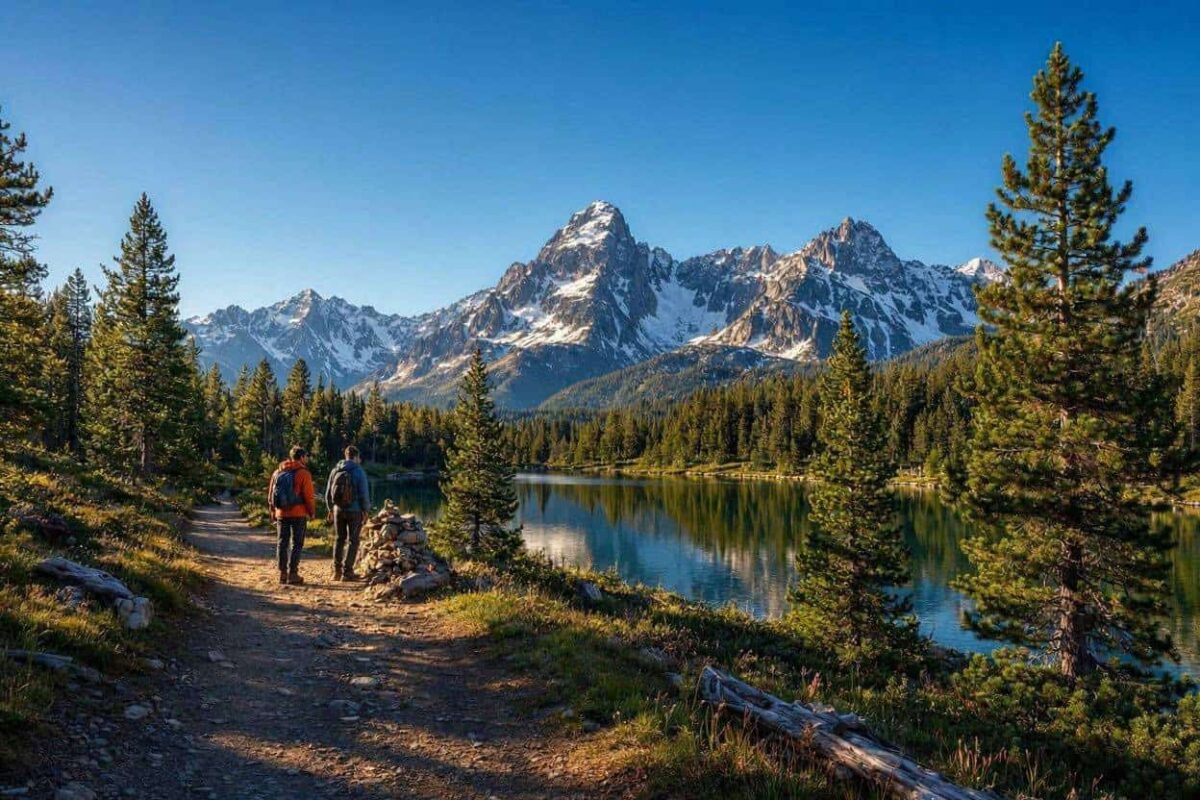
The best hikes in Grand Teton National Park sit inside a park that has over 242 miles of maintained trails spread across canyon floors, glacial lake shorelines, and alpine ridges that push well above treeline.
The range rises so sharply from the valley floor that even the easier trails deliver mountain views that take most visitors by surprise.
Trails are accessible from late May through October, with the ideal window running mid-July through early September when snow has cleared the high routes and the days are long enough to make the most of the elevation.
This guide goes trail by trail, tells you exactly what each one feels like underfoot, and helps you match the right hike to the time and fitness you actually have.
Taggart Lake
Taggart Lake is the hike that earns its reputation every single morning.
The trail covers 3.8 miles roundtrip with 420 feet of elevation gain, starting from the Taggart Lake Trailhead located off Teton Park Road about 3.5 miles from Moose Junction.
What makes it work as an introduction is that the Teton Range stays visible for the entire walk.
From the moment you leave the parking area, the peaks are in front of you.
The trail winds through sagebrush flats, passes through aspen groves and mixed forest, crosses the site of the 1985 Beaver Creek Fire where the open terrain gives the mountains room to dominate the skyline, and arrives at a glacially carved lake with Grand Teton, Middle Teton, and Teewinot Mountain rising directly above the water.
Arrive early. The parking lot fills fast on summer mornings and the lake is worth having to yourself for the first hour.
If you want more mileage, the Taggart and Bradley Lakes loop runs 5.9 miles and adds a second lake with a slightly higher elevation and considerably fewer people on the far shore.
Hidden Falls and Inspiration Point
Hidden Falls is the only accessible waterfall in Grand Teton National Park, and the combination of the waterfall and the Inspiration Point viewpoint above it is the most efficient use of a half-day in the park.
Take the Jenny Lake shuttle from the Jenny Lake Visitor Center to the west shore boat dock.
The shuttle runs every ten to fifteen minutes during summer and costs twenty dollars round trip.
From the dock, it is half a mile to Hidden Falls, a 200-foot cascade powered by snowmelt that runs strongest in June and early July.
The sound of it reaches you before the view does.
From Hidden Falls, continue another half mile uphill to Inspiration Point.
The trail climbs 250 feet on a rocky path that includes a section carved directly into the granite cliff face, built by Civilian Conservation Corps workers in the 1930s.
Watch your footing on the exposed ledge section, particularly with children.
At the top, at 7,220 feet, you look out over Jenny Lake, the full sweep of Jackson Hole valley, and the Gros Ventre Mountains to the east.
The view orients you to the entire park in a way that no map or viewpoint from the valley floor does.
Cascade Canyon
The Jenny Lake area offers several great trails, but the Cascade Canyon Trail is frequently rated as the top trail in Grand Teton and one of the best trails in the United States.
It earns that status because it gives you multiple experiences in a single route: the waterfall, the viewpoint, and then a canyon that opens gradually into some of the most dramatic mountain scenery in the American West.
The full trail covers 9.3 miles roundtrip from the west shore boat dock with 1,112 feet of elevation gain, taking four to seven hours depending on pace.
Take the shuttle across Jenny Lake to save two miles of walking each way and start the hike directly at the canyon mouth.
Beyond Inspiration Point the trail curves west and ascends gently along the north side of Cascade Creek.
The canyon walls rise on both sides as you gain elevation.
Teewinot Mountain, Mount Owen at 12,928 feet, and the summit of Grand Teton at 13,770 feet appear and disappear through the trees as the trail bends with the creek.
Moose are a consistent presence along the willow-choked creek bottom, most reliably in the early morning.
Black bears and grizzlies are active in the canyon. Carry bear spray in an accessible holster and make noise near the water where bears cannot hear you approach.
Most visitors turn around at the Forks of Cascade Canyon at 4.65 miles. Those who continue to Lake Solitude commit to a full day and earn the reward of an alpine lake tucked behind the Grand with an unobstructed view of the mountain on the walk back down.
Delta Lake
Delta Lake in Grand Teton National Park is one of the most beautiful hikes many visitors have ever done.
The lake is nestled right below Grand Teton and is definitely the best up-close view of the peak you can get, next to actually climbing it.
The trail to Delta Lake starts at the Lupine Meadows Trailhead, follows a maintained path for the first section, then becomes unmaintained as it crosses three boulder fields and finishes with a steep climb to the lake itself.
Navigation requires reading the terrain and following other hikers or cairns that are not always reliably placed.
The unmaintained section is not technically difficult but demands attention and comfort with route-finding.
For sunrise, the hike begins in darkness through grizzly country, which means bear spray, company, and a headlamp.
The payoff is a turquoise glacially carved lake with a direct view of the Grand Teton’s east face that no maintained trail in the park replicates.
It is the hike that experienced Teton visitors cite most consistently when asked which one stayed with them longest.
Death Canyon
Death Canyon, the Quieter Canyon runs parallel in character to Cascade Canyon but with a fraction of the foot traffic.
The trailhead sits off Moose-Wilson Road on a rough unpaved access road with significant potholes.
A vehicle with good clearance is strongly recommended, and campers are not allowed on Moose-Wilson Road.
From the trailhead, the first stop is Phelps Lake Overlook at 1.8 miles roundtrip, a sweeping view of the lake below and the valley floor that works as a standalone short hike or as a warmup before the canyon.
Past the overlook the trail descends to Phelps Lake and then climbs into Death Canyon itself.
The walls close in as you gain elevation and the feeling of scale shifts in the way that canyon hiking produces when the mountains are directly above you rather than across a valley.
The further you go the higher you climb, and looking back out the canyon mouth gives you a widening view of Phelps Lake and the Jackson Hole floor below.
Moose and bears are active in the canyon. Allot at least four hours to make the trip worth the drive to the trailhead.
Paintbrush Canyon to Cascade Canyon Loop
After spending two months hiking in Grand Teton National Park, the Paintbrush to Cascade loop, passing over Paintbrush Divide and stopping by Holly Lake and Lake Solitude, tops many experienced hikers’ lists as the best hike in Grand Teton National Park.
The loop runs 13 miles with 2,700 feet of elevation gain.
It requires an early start, a full water supply, and real weather awareness given its extended exposure above treeline where afternoon thunderstorms are a consistent summer occurrence.
The route can be hiked in either direction.
Many experienced hikers prefer Paintbrush Canyon on the ascent and Cascade Canyon on the descent, which puts the Lake Solitude section in the middle of the day when light is best for the views looking back toward the Grand.
The section above Holly Lake on the approach to Paintbrush Divide is the most demanding in terms of elevation gain and exposure.
From the divide the descent into Cascade Canyon begins, and Jenny Lake appears eventually below as the trail drops back toward the valley.
It is the trail that shows you what Grand Teton’s backcountry genuinely looks like beyond the canyon floors.
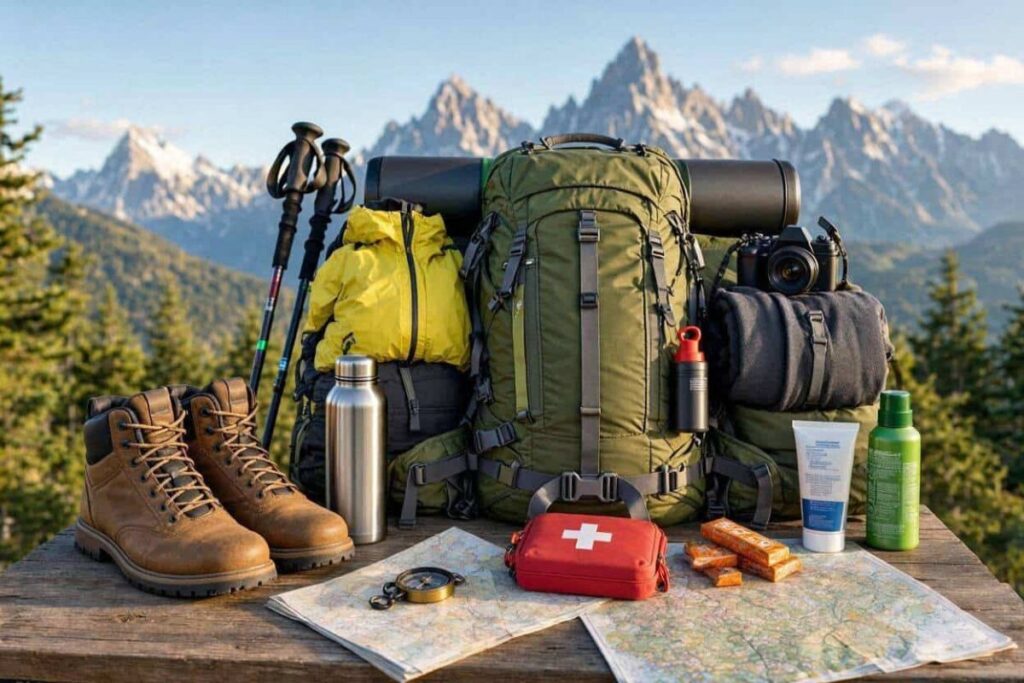
Needs for Hiking
Bear spray belongs on every person hiking beyond the lake trails, accessible on the hip rather than buried in the pack.
Water, extra layers for the temperature drop above treeline, sun protection for the open ridge sections, and a map of the trail are the essentials for any hike beyond a two-mile out-and-back.
Cell service is absent throughout most of the backcountry.
Parking fills fast at every major trailhead in summer. Jenny Lake lots are full by 9 AM on peak days.
Lupine Meadows, the starting point for Delta Lake and several other trails, fills even earlier on weekends.
Arriving before 7 AM is the reliable solution. The park’s current trail conditions, wildlife closures, and seasonal access updates are maintained on the Grand Teton National Park hiking page.
For readers planning accommodation around these trails, the best hotels near Grand Teton National Park guide on Tadexprof covers both in-park lodges and Jackson gateway options.
And for those combining this trip with Yellowstone, the best hikes in Yellowstone National Park guide covers the northern park’s trail network with the same level of detail.
Grand Teton rewards the hiker who shows up early, moves deliberately, and lets the trail set the pace. The views do not require the hardest route. They require showing up.