How to get to Death Valley National Park starts with one fact most visitors don’t expect, there is no commercial airport inside it.
The closest major one, Harry Reid International in Las Vegas, sits 105 miles southeast of the park, which means every trip here starts with a rental car and a drive rather than a shuttle from baggage claim.
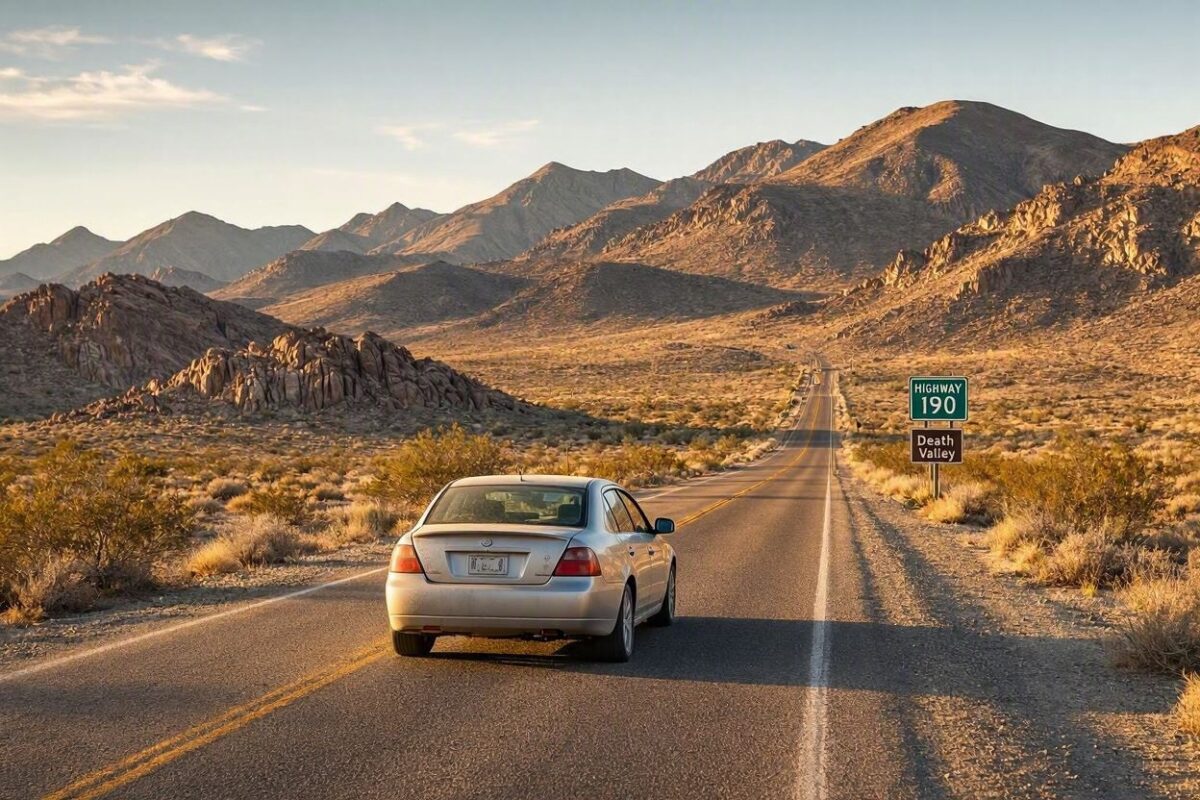
You do not need four-wheel drive to reach any of the main sights, since every entrance road into the park is paved, but you do need to plan around gas stations that are genuinely scarce, cell service that disappears for long stretches, and a GPS that cannot always be trusted once you’re inside the boundary.
The Closest Airport
Harry Reid International Airport in Las Vegas is the practical starting point for most visitors flying in from outside California, including many international visitors who build a Southwest road trip around Las Vegas as their arrival city
From there, the drive to Furnace Creek runs a little over two hours, mostly along open desert highway, which makes a full tank of gas and a rental car with decent range more important than people expect before they’ve actually seen how spread out this part of Nevada and California really is.
Travelers connecting through Los Angeles face a longer haul, closer to four hours, depending on which side of the park they’re entering from.
East Entrance
The east side offers the most entrance options, and most visitors coming from Las Vegas will use one of these.
CA-190 runs in from Death Valley Junction, SR-374 connects from Beatty, Nevada, CA-178 comes in from Shoshone, California, and SR-267 links up from US-95 in Nevada.
All four are paved and reliable in normal weather, and which one makes sense depends mostly on where you’re coming from and whether Beatty or Pahrump is already part of your route.
West Entrance
Visitors approaching from the Sierra Nevada side, often after a stop in Lone Pine or the Eastern Sierra, typically enter on CA-190 from Olancha, reached via SR-136 out of Lone Pine, or on SR-178, also called Panamint Valley Road, from Trona.
This route tends to appeal to travelers already working through a California-heavy itinerary rather than the Las Vegas-anchored trips more common among first-time visitors.
Essentials
Inside the park, there are exactly three places to buy gas: The Oasis at Death Valley in Furnace Creek, which sells two grades plus diesel, Panamint Springs Resort, which sells gasoline and diesel, and Stovepipe Wells, which sells only 87-octane gasoline and no diesel at all.
Running low on fuel in a park this size, where the nearest full grocery store sits in Pahrump, Nevada, 47 miles southeast, is the kind of mistake that turns a day trip into an emergency.
Electric vehicle drivers face a sharper version of the same problem.
There are no rapid chargers inside the park at all, and the nearest ones sit in Beatty, Nevada, 43 miles from Furnace Creek.
The destination chargers at the Inn and Ranch at Death Valley exist but have a history of reliability issues, and Stovepipe Wells offers four chargers of its own, though all of them can back up quickly during peak season when every other EV driver in the park is trying to use the same handful of plugs.
Anyone renting an EV for this leg of a Southwest trip should treat charging logistics the same way they’d treat travel insurance, as a cost worth planning for rather than an afterthought.
Navigation Issues
Beyond the paved entrances, a number of dirt roads lead into the park, including Wildrose Canyon Road, Harry Wade Road, Titus Canyon Road, and Saline Valley Road, but these come with a real warning attached: no cell service, no nearby help, and long enough distances that visitors are expected to be prepared to self-rescue rather than call for one.
GPS apps are also known to give unreliable directions once you’re inside the park, and Furnace Creek Visitor Center doesn’t even have a conventional street address, only map coordinates.
None of this is meant to scare off a first-time visitor, but it does mean printing a real map or downloading offline directions before you leave cell coverage behind is worth the ten minutes it takes.
Planning a Longer Trip
Since most visitors are already routing through Las Vegas or the Eastern Sierra, Death Valley rarely stands alone on an itinerary.
The Death Valley National Park guide covers timing, safety, and lodging in more depth than fits here, and it’s worth a read before locking in an arrival date, since the entrance road that makes sense often depends on when in the season you’re coming and where you’re staying.
For travelers combining the park with a wider Southwest loop, our guide to visiting Zion is a natural next stop to plan around, since the driving distances between these parks shape how many nights each one actually needs.
For the full breakdown of entrance roads, gas stations, and EV charging details straight from the source, the National Parks Traveler guide to getting to Death Valley is kept current and is worth a final check before departure, since charger reliability and road conditions can shift from one season to the next.
None of the logistics here are complicated once you know them, but they do reward planning ahead in a way that flatter, better-serviced parks don’t.
Fill the tank before you think you need to, print a map you don’t have to trust a signal to load, and treat the drive itself as part of the experience rather than an obstacle standing between you and Badwater Basin.
What’s the closest airport to Death Valley National Park?
Harry Reid International Airport in Las Vegas, about 105 miles southeast of the park.
From there, plan on a little over two hours of driving to reach Furnace Creek, mostly along open desert highway.
Where can I buy gas inside the park?
There are only three options: The Oasis at Death Valley in Furnace Creek, which sells two grades plus diesel, Panamint Springs Resort, which sells gasoline and diesel, and Stovepipe Wells, which sells only 87-octane gasoline with no diesel.
Fill up before you think you need to, since the nearest full grocery store is 47 miles away in Pahrump, Nevada.
Can I charge an electric vehicle in Death Valley?
Not quickly. There are no rapid chargers inside the park, and the nearest ones sit in Beatty, Nevada, 43 miles from Furnace Creek.
Destination chargers exist at the Inn and Ranch at Death Valley but have reliability issues, and Stovepipe Wells’ four chargers can back up fast during peak season.