Zion National Park sits in the canyon country of southwestern Utah, about 160 miles northeast of Las Vegas and 310 miles south of Salt Lake City.
Those two cities are the realistic arrival points for most visitors, and the choice between them shapes the entire trip budget in ways that are worth thinking through before booking anything.
For the large majority of travelers flying in from the United States, Canada, or internationally from Germany who need to know how to get to Zion National Park, Las Vegas is the cheaper airport to fly into, the rental car market there is significantly larger and more competitive, and the drive to Zion from Las Vegas takes roughly two and a half hours on Interstate 15 north.
Salt Lake City is the better choice for travelers who are combining Zion with Utah’s northern parks or coming from the Pacific Northwest by road.
Getting this foundational decision right, before worrying about which trailhead to prioritize or what time to arrive at the shuttle stop, is the kind of planning that separates a smooth trip from an expensive one.
Flights into Las Vegas are cheaper year-round than flights into St. George Regional Airport, the closest commercial airport to Zion at about 45 minutes away, because the volume and competition at a major hub airport simply cannot be matched by a small regional one.
The price difference often more than covers the longer drive.
The Las Vegas
Driving from Las Vegas to Zion on Interstate 15 north is the most common route into the park and one of the more straightforward drives in the American Southwest.
The highway runs through the Mojave Desert, crosses into Utah, and passes through St. George before the landscape starts shifting toward the canyon country that signals the park is close.
The town of Springdale sits at Zion’s main south entrance, and the drive from Las Vegas to Springdale runs about 160 miles and takes two and a half to three hours depending on traffic through the Las Vegas metro area.
Stopping in St. George for fuel, food, or a hotel night makes logistical sense for many visitors.
The city is the largest in the region, with a full range of accommodation and dining options at prices well below what Springdale charges during peak season.
For travelers arriving on late flights into Las Vegas who do not want to drive the full route at night, St. George is the natural halfway point.
It also positions the trip well for an early morning arrival at Zion, which matters practically since parking in Springdale and at the park’s visitor center fills up quickly on busy days.
The Salt Lake City
Salt Lake City works as the entry point for travelers building a Utah road trip that moves south through multiple parks.
The drive from Salt Lake to Zion runs about 310 miles and takes four and a half to five hours on Interstate 15 south.
Anyone covering Bryce Canyon on the same trip will find that the routing naturally places Bryce between Salt Lake and Zion, which the best time to visit Zion National Park guide on this site also addresses in terms of how seasonal timing affects both parks differently.
Rental car pricing in Salt Lake City sits between Las Vegas and St. George in terms of cost and availability.
The airport handles enough volume that competitive rates are available, but the deeper Las Vegas market will almost always offer a lower daily rate for the same vehicle class.
The Four Entrances
Zion has four entrances, and most visitors use only one without knowing the others exist.
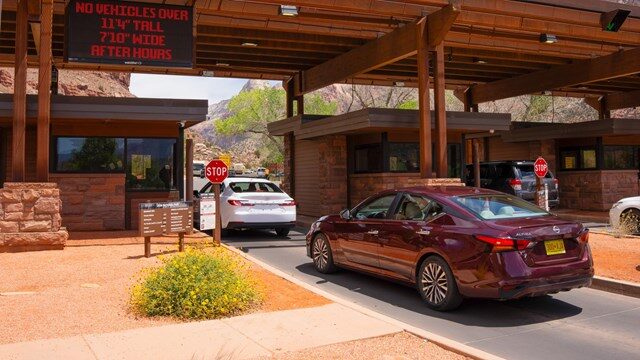
The main south entrance through Springdale leads directly into Zion Canyon, where the shuttle system operates and where the park’s most famous trails, Angels Landing, the Narrows, Emerald Pools, originate.
This is the entrance that serves the overwhelming majority of visitor traffic and the one that all driving directions default to.
The east entrance on Zion-Mount Carmel Highway is the second most used.
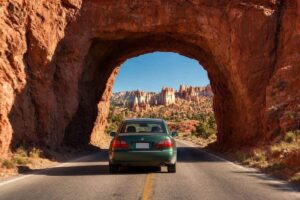
It enters the park from the direction of Bryce Canyon and the Grand Staircase-Escalante region and passes through the Zion-Mount Carmel Tunnel, a historic single-lane tunnel that requires vehicles over a certain size to pay an escort fee and wait for clearance.
RV travelers and those in large pickup trucks should check current requirements on the NPS Zion conditions page before using this entrance.
Kolob Canyons, accessible off Interstate 15 on the park’s western boundary, is a stand-alone section of the park with its own entrance station, short scenic road, and hiking trails.
It is dramatically less crowded than Zion Canyon and worth building into a trip that has an extra half day.
Kolob Terrace Road heads north from the town of Virgin toward a more remote section of the park where longer backcountry routes including the famous Subway hike originate.
Both of these lesser-known sections reward visitors who have already explored the main canyon or who specifically want to avoid the peak-season crowds concentrated at the south entrance.
Driving inside the Park
Once inside Zion Canyon, private vehicles are restricted from the main scenic drive from roughly March through November, which is shuttle season.
The park shuttle system connects the visitor center to all major trailheads and runs frequently during peak hours.
This is the primary transportation system for the canyon during peak season, and understanding it before arrival removes a significant source of visitor frustration.
Parking at the visitor center fills completely by mid-morning on busy days, often before 9 a.m. in summer.
The practical solution is to stay in Springdale and use the free town shuttle to reach the park, or to arrive early enough to secure visitor center parking before the lot fills.
Anyone arriving after 9 a.m. on a peak season weekend should plan to park in Springdale from the outset rather than attempting the visitor center lot.
The Rental Car
A rental car is essential for getting to Zion from either Las Vegas or Salt Lake City. There is no practical way to reach the park without one unless you are joining an organized tour.
For visitors who want to combine Zion with additional Utah destinations, the rental is a fixed cost that distributes across the whole itinerary.
A four-day circuit covering Zion and Bryce Canyon from a Las Vegas rental requires roughly 500 to 600 miles of driving in total, which at standard rental rates and fuel costs represents a meaningful but manageable line item in the overall trip budget.
Canadian and German travelers booking US rental cars should book early and through a major agency with a large Las Vegas fleet.
Rates at peak travel times, particularly spring break and the summer months, climb significantly as inventory tightens.
Booking three to four months ahead for a summer trip is not excessive caution. It reflects how the Las Vegas rental market behaves under peak demand.
Drive Experience
The approach to Zion on Highway 9 from Interstate 15, through the Virgin River Gorge and into the canyon country around Rockville and Springdale, is one of the better stretches of driving in Utah.
The red sandstone formations begin appearing well before the park entrance, and by the time Springdale comes into view with the canyon walls rising directly behind the town, the destination has announced itself unmistakably.
For the full picture of what awaits inside, the where to stay in Zion National Park guide covers lodging from Zion Lodge to Springdale hotels across different budgets, which is the next decision most travelers face once the route in is settled.
The logistics are manageable. The planning is what makes them feel that way.