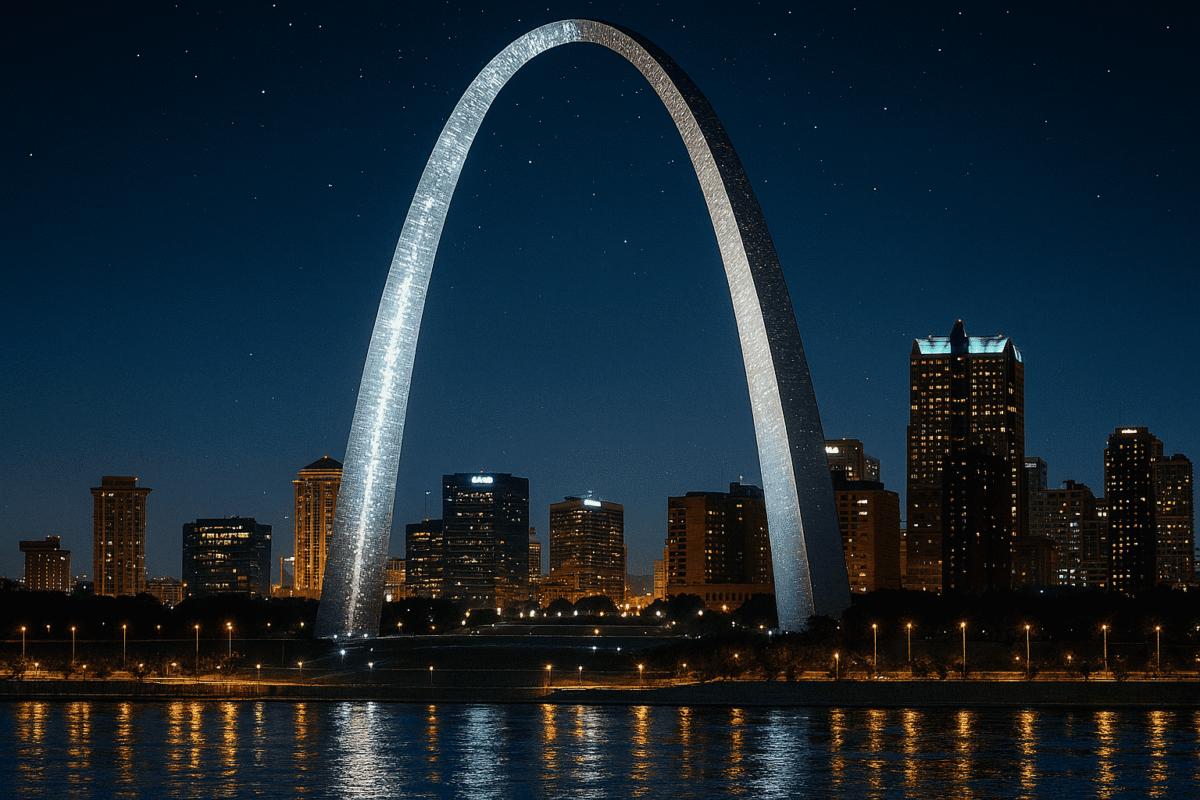
Gateway Arch National Park is in downtown St. Louis, Missouri, on the west bank of the Mississippi River.
It is the smallest national park in the United States at just 91 acres, and it is the only one built around a single man-made structure.
The park is free to enter, the museum beneath the Arch is free, and the Old Courthouse a short walk away is free.
The tram ride to the top of the 630-foot stainless steel arch costs around $17 for adults, and it sells out early enough on busy days that booking in advance is not optional advice but a practical requirement.
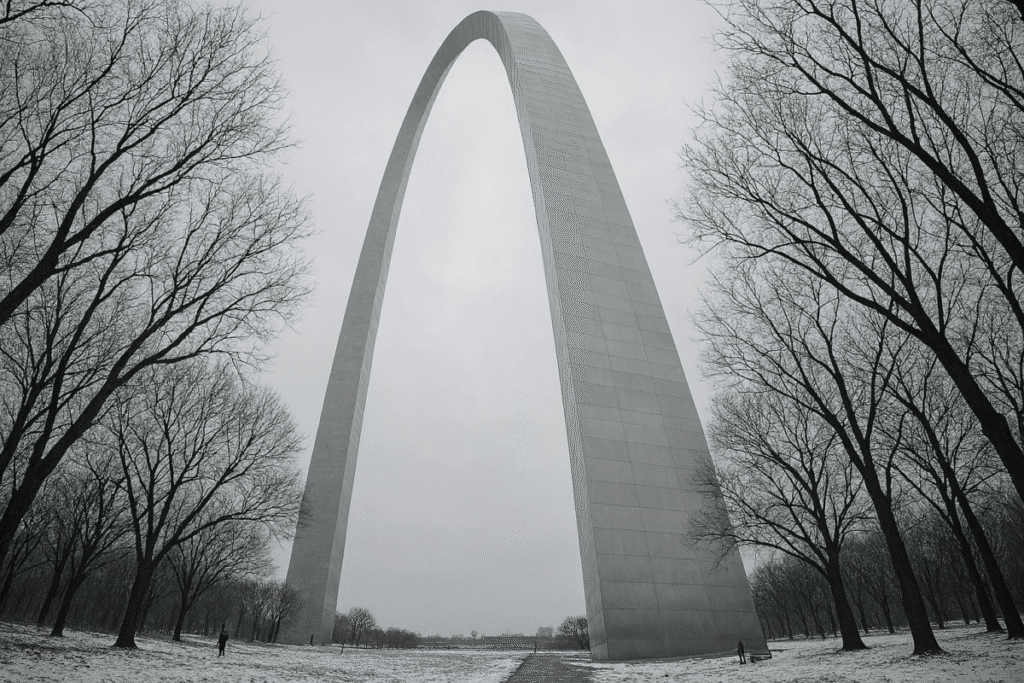
The Arch is the tallest man-made monument in the Western Hemisphere, taller than the Washington Monument, taller than the Statue of Liberty from base to torch, and visible from miles away across the flat Mississippi floodplain.
For American road trippers crossing the country through the Midwest, Canadian visitors making a first pass through the American interior, and German travelers who tend to approach cities through architecture and history before outdoor recreation, Gateway Arch National Park is a half-day stop that carries more weight than its footprint suggests.
The Arch
Finnish-American architect Eero Saarinen submitted his design for the arch in 1947 as part of a national competition to create a memorial on the St. Louis riverfront. He won out of 172 submissions.
His design is a weighted catenary curve, the mathematical shape a free-hanging chain makes under its own weight, scaled to 630 feet tall and 630 feet wide from leg to leg.
Saarinen died of a brain tumor in 1961, four years before construction was completed. He never saw it built.
Construction ran from February 1963 to October 1965 and came in at around $13 million with no loss of life, despite workers operating at heights that would not be permitted under modern safety standards. The monument opened to the public in 1967.
The tram system inside the arch is its own engineering story.
Architect Saarinen tasked Dick Bowser, a second-generation elevator manufacturer without a college degree, to design a way to transport visitors through a curved structure to an observation deck 630 feet in the air.
Bowser had two weeks to come up with a concept and designed a system of barrel-shaped capsules strung together on tracks, each fitting five passengers, that pivot as they travel the curve of the arch.
The four-minute ride up is genuinely unlike any other form of transit, and visitors with claustrophobia should think through whether they are comfortable in a very small pod before booking.
The observation deck allows about 10 minutes at the top, with windows looking east over the Mississippi River into Illinois and west over the St. Louis skyline.
The Museum
The museum beneath the arch, accessible free of charge, was significantly expanded in a $380 million renovation completed in 2018 that also added 11 acres of parkland and improved connections between the arch and the surrounding city.
Six galleries cover colonial St. Louis, Jefferson’s vision of a continental nation, the riverfront era of the 1800s, Manifest Destiny and westward expansion, the stories of people who made the journey west, and the construction of the arch itself.
The renovation made a serious effort to include perspectives that earlier versions of the museum ignored, among them the experiences of Native Americans on whose land westward expansion moved, and the lives of the enslaved people and free Black residents of St. Louis who had no say in what the 19th century’s push toward the Pacific cost them.
The 35-minute documentary film “Monument to the Dream,” available for a separate ticket, covers the arch’s construction in detail and was nominated for an Academy Award for Best Documentary Short in 1968.
Most visitors who watch it before taking the tram report a meaningfully different experience riding up than those who skip it and go straight to the ride. The math on that extra 35 minutes is worth running.
The Old Courthouse and the Dred Scott Case
The Old Courthouse, about a five-minute walk from the arch’s west entrance across Luther Ely Smith Square, is part of the national park and free to visit.
The building dates to 1828, with its current form including a dome modeled on St. Peter’s Basilica completed by the 1860s. It is most significant as the site of the first two trials of the Dred Scott case, heard in 1847 and 1850.
Dred Scott and his wife Harriet sued for their freedom on the grounds that they had lived in free territories. Scott won his initial case in the St. Louis Circuit Court.
The case was eventually overturned by the US Supreme Court in 1857 in a ruling that declared enslaved people were not citizens and had no right to sue in federal court, a decision that intensified the national crisis over slavery and is widely regarded as one of the catalysts of the Civil War.
More than 300 other freedom suits were filed in the same courthouse before 1860, a fact the park now acknowledges more directly than earlier interpretations did.
The Old Courthouse completed a significant renovation in 2025, with new galleries and restored courtrooms.
Checking current hours and exhibition status on the official Gateway Arch National Park website before visiting is worth doing, as programming and access can vary.
Planning the Visit
The park grounds are open from 5 a.m. to 11 p.m. year-round. The visitor center and museum are open daily from 9 a.m. to 6 p.m., with extended Friday and Saturday hours to 8 p.m. during summer.
The park is closed on Thanksgiving, Christmas, and New Year’s Day.
Tram tickets, documentary film tickets, and the virtual reality experience all require separate purchase and should be booked in advance through the official ticketing site, particularly for summer weekends when the tram sells out days ahead.
Getting to the park without a car is manageable. The MetroLink light rail system connects St. Louis Lambert International Airport to the Laclede’s Landing station, a short walk from the park entrance.
Preferred parking is available at the Stadium East Garage two blocks from the entrance, bookable in advance at a discounted rate through the arch’s website.
The America the Beautiful annual interagency pass covers the $3 park entrance fee embedded in tram and film ticket prices, making it worth bringing if you already hold one.
A visit to Gateway Arch pairs naturally with a broader St. Louis day. Forest Park, a few miles west of downtown, is larger than Central Park in New York and contains the St. Louis Zoo, the St. Louis Art Museum, and the Missouri History Museum, all free.
The park fits into a cross-country road trip through the American interior as efficiently as any stop on that route.
For visitors building a full national parks itinerary and wanting to understand how the park system maps across the country before committing to routing decisions, the national park map by state gives a useful geographic overview.
The arch draws around two million visitors a year and has been doing so for more than six decades.It is not a wilderness experience or a scenic drive.
It is a 630-foot steel arch that a Finnish-American architect won the right to design in a national competition in 1947, built by a few hundred workers over two and a half years on the banks of a river that once marked the edge of the known American world.
The story of what happened on both sides of that edge is what the park has spent the past several years learning how to tell.