Most people pack for Zion National Park the same way they would for a warm-weather hiking trip. They throw in a T-shirt, shorts, trail shoes, sunscreen, and a water bottle and assume they’re prepared. Some of them end up having a fine time.
Others end up shivering at the rim of Angels Landing because they didn’t account for how fast the temperature drops at elevation when a cloud rolls in, or standing at the edge of the Virgin River realizing that their cotton hiking clothes are going to make wading the Narrows genuinely miserable.
Zion National Park is not a complicated park to pack for, but it demands more thought than most visitors give it.
The canyon sits between 4,000 and 8,000 feet of elevation. The desert sun at that altitude drives UV exposure significantly higher than at sea level.
The afternoon temperatures in summer can push well past 100 degrees Fahrenheit on the canyon floor while the rim and upper trails run 20 degrees cooler.
And if the Narrows is on the itinerary, you are hiking through a river, which changes the equipment requirements entirely.
Getting the packing right means understanding what the park actually is, not just what it looks like in photographs.
All-weather Clothing
The foundation of a Zion National Park packing list is a layering system, and this holds whether the trip is in spring, summer, or fall.
A moisture-wicking base layer, either merino wool or synthetic, manages sweat without holding dampness against the skin. A midweight fleece or insulated layer goes on top when temperatures drop.
A wind and water resistant shell sits over everything for rain or exposed ridgelines.
Those three layers cover the full temperature range the Park can produce, and they pack small enough that carrying all three adds almost nothing to a day pack.
Cotton is the one material that fails visibly in this environment. When cotton absorbs moisture from sweat or river water, it stays wet and pulls warmth away from the body, which is uncomfortable on a summer trail and genuinely dangerous in cooler conditions.
Wool and synthetic fabrics move moisture outward and dry fast. For German visitors whose outdoor gear culture leans toward technical fabrics, this distinction is familiar. For American travelers who default to a cotton t-shirt and jeans for a day in the park, it is worth reconsidering before the trip.
Spring deserves particular attention. March and April in Zion National Park can deliver a warm afternoon and a cold snap within hours.
Temperatures swing dramatically between morning and midday, sometimes by 30 degrees Fahrenheit or more. A light fleece and a packable rain layer are not optional extras in spring.
They are the minimum sensible preparation for a day that may start at 45 degrees and climb to 75.
Sun Protection
The combination of desert air and elevation makes UV exposure in Zion meaningfully more intense than at sea level.
Sunscreen with SPF 30 or higher, applied before leaving accommodation and reapplied during the day, is the baseline. Zinc-based formulas tend to hold up better during active sweating than chemical sunscreens.
A wide-brimmed hat protects the face, neck, and ears, which are the areas most people underestimate. Sunglasses with UV protection are not an accessory.
The open sandstone terrain reflects light from multiple directions and eye fatigue on a long day on the trail is real.
Zion Guru, one of the park’s most respected local outfitters, recommends a minimum of 1.5 liters of water per person per four hours of hiking as a baseline. nps That figure assumes moderate temperatures and moderate exertion.
Summer conditions in Zion National park push both of those variables beyond moderate, and carrying at least three liters for a full day on trail is a more realistic target.
The park has water refill stations at the Temple of Sinawava at the end of the shuttle route, at The Grotto, and at Zion Lodge, which are worth noting as mid-hike refill points on longer routes.
Reliable Footwear
Trail runners or light hiking boots with ankle support work well for most valley and mid-elevation trails. The critical rule is that whatever goes on trail should already be broken in before arrival.
A full day on Zion’s rocky sandstone paths with new footwear produces blisters that can end a trip early or make the remaining days painful.
Wearing new boots in the weeks before departure is the kind of preparation that seems excessive until it isn’t.
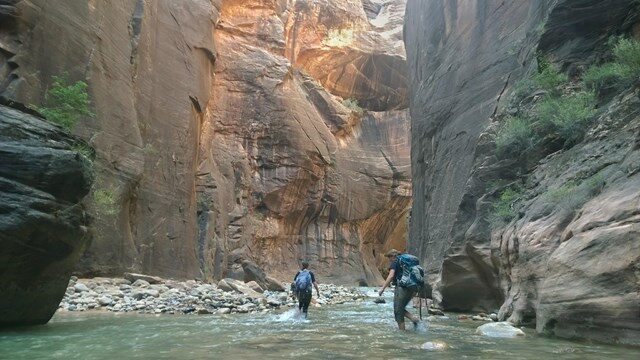
The Narrows changes the footwear calculation completely. The trail runs through the Virgin River itself, over rounded, slippery, submerged rocks, for as far in as the hiker chooses to go.
Sturdy closed-toe water shoes or canyoneering footwear give the most protection against the unstable riverbed. Neoprene socks, which hold warmth against cold water, are advisable in spring, fall, and any early morning summer Narrows hike where the river has not yet had time to warm.
The Virgin River runs cold enough that most people find it refreshing in summer but genuinely uncomfortable in fall without some form of insulation on the feet. nps
Packing Category
The Narrows is Zion’s most iconic hike and requires treating as its own gear category rather than an extension of standard hiking preparation.
Beyond appropriate footwear, a dry bag or waterproof pack cover keeps food, a phone, and any electronic items protected from repeated submersion.
A trekking pole provides stability on the uneven riverbed, and most visitors who attempt the Narrows without one and later do it with one describe the difference as significant.
One detail that surprises many first-time Narrows hikers is that the Virgin River carries toxic cyanobacteria, which means the water cannot be drunk even with a filter or treatment method. nps All water for the Narrows hike must be carried in from the trailhead.
On a long Narrows day in summer, that means carrying more water than a typical trail hike of equivalent length would require, because there is no reliable source along the route.
Gear rentals for the Narrows, including canyoneering shoes, neoprene socks, dry bags, and trekking poles, are available from outfitters in Springdale.
Booking rentals in advance is worth doing, particularly during peak season when demand outruns supply. The NPS Zion current conditions page posts Narrows status and flash flood risk daily, and checking it the morning of any planned Narrows hike is non-negotiable.
Permits and Passes
The America the Beautiful annual interagency pass at $80 covers Zion’s vehicle entrance fee and every other federal land entrance for a full year.
For any traveler visiting three or more national parks in a twelve-month period, it pays for itself within the first two parks.
Angels Landing requires a permit obtained through a lottery that opens months in advance.
Anyone whose trip centers on that hike should resolve the permit question before planning anything else around it.
For visitors who are building a broader Utah itinerary that includes Zion alongside the canyon country to the north and east, the best time to visit Zion National Park guide on this site covers how seasonal conditions affect which gear matters most and when each trail is realistically accessible.
Pack Essentials
A well-chosen 20 to 25-liter day pack covers most Zion hiking needs without excess weight.
What goes inside it, appropriate layers, enough water, sun protection, broken-in footwear, a downloaded offline map since cell coverage across much of the canyon is unreliable, and snacks with real caloric density rather than chips and candy, determines how the day on trail actually feels.
Zion National Park is generous to people who show up with the right equipment and clear about the consequences when they don’t. The preparation is quiet, mostly done at home in the week before departure.
The payoff is the ability to be fully present in one of the more remarkable landscapes on the continent without spending mental energy managing avoidable problems.