Best time to visit Yellowstone National Park depends entirely on what you want to experience when you get there.
The best times, broadly speaking, are late April to May and September through early October, when the weather is mild, crowds are manageable, and road closures are largely behind or ahead of you.
But that framing skips over winter, which offers something no other season can, and understates how dramatically summer changes the park’s character for better and worse. Every season has a real argument for it. This is what each one actually looks like on the ground.
Spring in Yellowstone
Spring is the most underrated season in Yellowstone and the one that rewards visitors who do not need everything to be open and convenient.
April and May deliver exceptional wildlife watching during baby season and the lowest accommodation prices of any warm-weather month, though weather remains unpredictable and some roads stay closed into late May.
Bison calves, bear cubs, and wolf pups appear in this window, and the Lamar Valley in the northeast corner of the park is where most serious wildlife viewers position themselves at dawn.
The crowds are a fraction of what July brings, which means actually stopping and watching rather than idling in a line of vehicles.
The financial case for a spring trip is significant. In-park lodging rates sit at their seasonal floor, and availability that would be impossible to find in August is sometimes bookable just weeks out.
For families traveling from Canada or the American midwest where school spring break calendars create a narrow travel window, early May in Yellowstone is consistently better value than the same trip in July by almost every measure except road access and facility hours.
One honest caveat is weather. Spring temperatures are unpredictable, and snow is genuinely possible through late May at the park’s higher elevations.
Packing for three climates in a single day is not an exaggeration at this time of year.
The Summer Surge
July is the peak month for Yellowstone visitation, with nearly one million people visiting in that month alone, contributing to the park’s total of over 4.7 million annual visitors, the majority of whom arrive during the summer months.
None of that makes summer wrong. Daytime temperatures range from 50 to 80 degrees Fahrenheit, making it ideal for hiking and exploring, all roads and facilities are fully operational, and the park’s ranger program runs at full capacity.
For first-time visitors who want every trail open, every geyser basin accessible, and every lodge dining room operating, summer is when the park performs at its most complete.
Families constrained by school calendars often have no other realistic window, and the park handles that reality competently even if it cannot make the parking situation elegant.
The practical advice for summer is simple: move early and move late. Arriving at major viewpoints before 8 a.m. or after 5 p.m. changes the experience entirely.
The geysers erupt on the same schedule regardless of what time you arrive. The crowds do not.
Fall is the Strongest Season
September is the best time to visit Yellowstone for most people. Average highs reach 63 degrees Fahrenheit, overnight lows drop to around 30, and crowds thin dramatically after Labor Day with roughly 45 percent fewer visitors than the July peak.
Elk rutting season peaks in mid-September and turns the meadows around Madison and Mammoth into genuine wildlife theater. Bull elk bugle across open fields, and the sound carries in the cooler morning air in a way that has no summer equivalent.
Grizzlies are entering hyperphagia, feeding aggressively before hibernation, and sightings along the Lamar Valley and near Yellowstone Lake become more frequent and longer in duration.
October empties the parking lots even as lodges begin shutting down for the season, and fall colors turn the aspen groves gold through mid-month. The North Rim of the Grand Canyon of the Yellowstone is particularly dramatic in this light.
The tradeoff is that lodging options narrow as properties close sequentially through October, and the window between ideal conditions and winter closures is tighter than it appears on a calendar.
Visitors planning a fall trip from Germany or other parts of Europe where October travel is common should confirm lodge operating dates before finalizing flights.
For anyone combining Yellowstone with Grand Teton or the Grand Canyon as part of a longer American West itinerary, the fall timing aligns across all three destinations in a way that spring and summer cannot match as cleanly.
Our Grand Canyon National Park guide covers how fall shifts the experience there, which is worth reading before finalizing a multi-park schedule.
Winter in Yellowstone
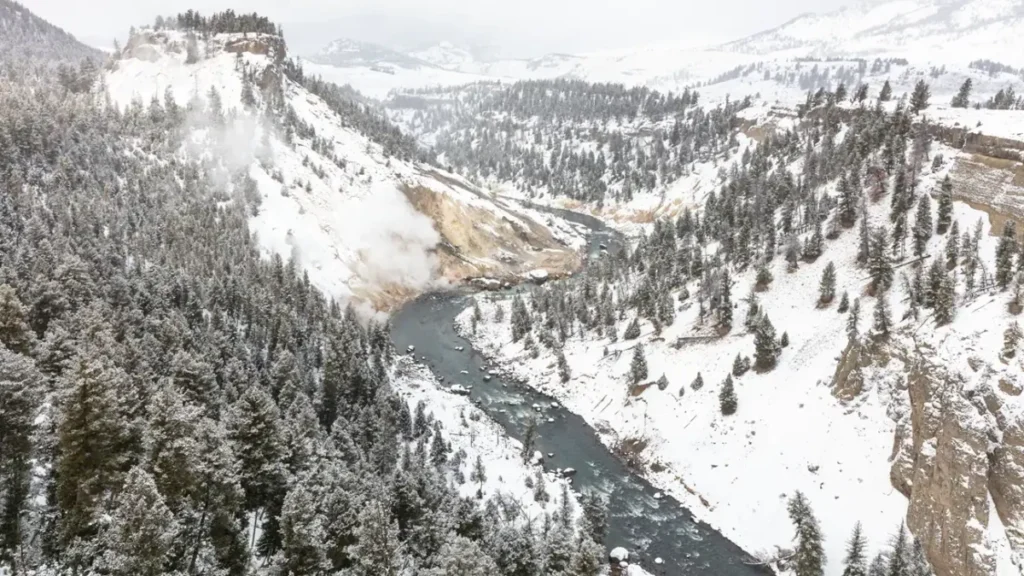
Winter transforms Yellowstone into a snow-covered landscape with unique wildlife viewing opportunities and dramatically reduced visitor numbers, accessible between December and March.
Most of the park’s road network is closed to wheeled vehicles in winter.
Access to the interior requires a commercially operated snowcoach or snowmobile, which adds cost and planning complexity that most casual visitors are not prepared for.
What it gives back is a version of Yellowstone that only a small percentage of the park’s annual visitors ever witness.
Bison stand in geothermal steam vents in temperatures well below zero. Wolf packs move across open snowfields with no foliage to obscure them.
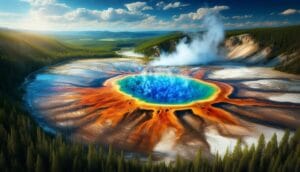
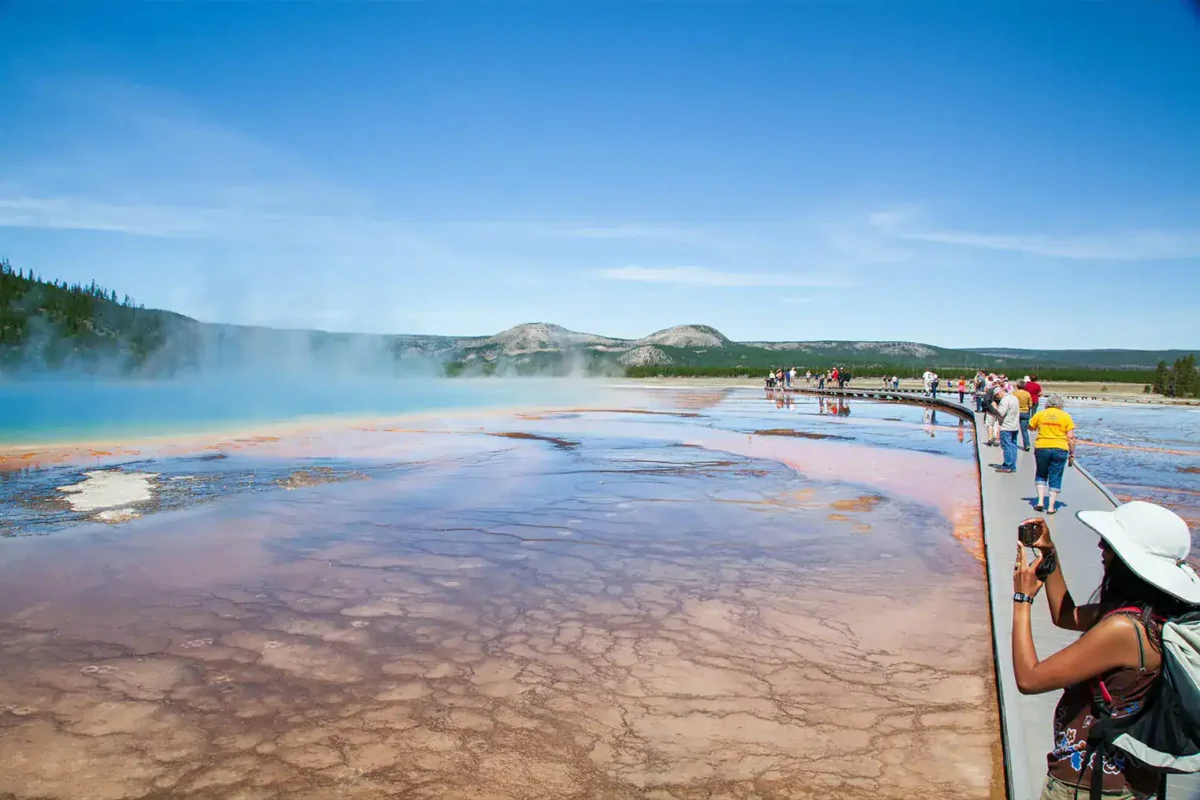
The Grand Prismatic Spring produces its most vivid color in cold air.
The two lodges open in winter, Old Faithful Snow Lodge and Mammoth Hot Springs Hotel, host a guest profile that skews toward experienced travelers who have already done the summer version and want something completely different.
For Canadian visitors accustomed to winter travel infrastructure and European visitors from colder climates with strong outdoor recreation habits, Yellowstone in January is a genuinely compelling proposition.
The NPS publishes current road conditions, seasonal opening dates, and winter access guidelines at nps.gov/yell, which is the right place to verify current status before committing to any dates.
Yellowstone does not have a bad season. It has seasons that suit different kinds of travelers, and the mistake most people make is assuming that the busiest version of the park is automatically the best one.