Igangan-Ijesha: This is one of my articles written as an undergraduate. I love to know more about local places, and local culturess. I use my blog to keep developing my duckling skills as I get to know more about several local places. Tadese Faforiji, a student of history.
I hardly slept during the Arake festival to witness the rituals involved, but unfortunately, we were to be indoors starting from 3 pm.
Where is Igangan?
Igangan-Ijesha, also Igangan-Amuta Gesi, is an ancient town in the southwestern part of Ilesha, Osun State, Nigeria. It is about 12½ kilometres away from Ilesha with 25m of land. Like other Yoruba communities, the now Igangan-Ijesha had been in existence for over 650 years ago.
They earned a reputation for tremendous success in agriculture and for holding a strong cultural value.
Now, it is now an urbanized city that enjoys adequate electricity, water supply, and other needs for human survival, which graded the community development and drove her to apogee.
Founded about 600 years ago, Igangan-Ijesha now has 26 vassal communities that revere the beaded crown Loye of Igangan-Ijesha.

History of Igangan
It is not unusual to trace the history of any contemporary Yoruba community to the great Ile-Ife, the cradle of the Yorubas.
Igangan-Ijesha was established by Arake, who migrated from Oke-Ahun, Efon Alaaye (currently in Ekiti State). Arake initiated the process of forming a new state while still holding onto his chieftaincy title.
Igangan-Ijesha was then like a manorial settlement. The emergence of a viable kingship institution could be posited to be the efforts of Adejoorin, who journeyed from Ila-Oragun and settled at Igangan-Ijesha after signing a ‘modus-Vivendi’s pact with Arake, the premier chief.
Arake was the chief while Adejoorin was the king. A situation that is known as ‘contrapuntal paramountcy.’ So, therefore, led to the development of the monarchical system, which remains till today.
According to Oba Adetomiwa Akanni Lucas, the 28th Loye of Igangan-Ijesha, the chiefs (names of chieftaincy positions in Igangan-Ijesha) and the king worked hand-in-hand to govern the early settlers.
Unlike other parts of Nigeria, the pact was more of cooperation, love, harmony and which later led to prosperity.
These two figures- Arake and Adejoorin- are the founders of Igangan-Ijesha. Perhaps the vassal communities were captured by Adejoorin, who culturally set up the kingship institution when he became the first king and Arake the first chief. The efforts of both figures led to what is now Igangan-Ijesha.
Igangan-Ijesha: Political System
The political history of this community depicts a kind of monarchical system of government synonymous with the Old Oyo Empire’s archaic and ancient system of administration.
A monarchical system emerged in this region following the consolidation of the place by the aforementioned figures.
Full list of 75 countries banned by the US from visa processing
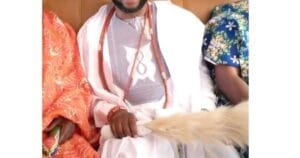
It had been under many Kings and notably, there were always unique developments under these kings. Typically, Oba Adetomiwa Thomas Lucas, the 28th Loye of Igangan-Ijesha ruled from the palace.
A paradigm shift to the place of the then Kings. He is a crowned king. This portrays the summitry position of an honourable ruler.
Loye is the title of the King of Igangan Ijesha. This title took the beginning from the community’s cultural history. It relates to the preservation of the cultural heritage of the people.
The political institution is a kingship institution, just like other Yoruba communities. The kingship institution is of course a perfect framework for furthering the security of the community as well as economic development.

The king rules the people and the chiefs play significant roles in the administration of the community. They advise the Oba in policymaking and other things.
The king and chiefs play vital roles in establishing a network for community security, fostering peace, harmony, and promoting community integration, ultimately contributing to good governance.
Igangan Chiefs
Among the chiefs are Saba, Town Crier, Olori Omo, etc. which constitute the majority of the Ajo-Ilu Legislative Assembly.
Each chief has a different role he/she plays to support the king. The town crier, for instance, imparts the message of the Oba to the people in the community.
Now the role of this office faces challenges of civilization as television and radio handle such announcements today. However, the town crier still covers the area of Oba- Community diplomacy. Summarily, the political system is monarchical and democratic in nature.
Igangan-Ijesha: Economy
The mainstay of the economy is agriculture. Igangan-Ijesha has thrived in producing agricultural produce historically and fortunately she still currently holds a significant position in the production of cash crops- like cocoa, kola nut, oil palm- as well as arable crops.
The rich land favours agricultural practice. It has two seasons in the 12-month calendar. The rainy season is from May to practically November, and the dry season is from December to April.
The rainiest months are July and September. The soothing ecological condition attracts settlers to different parts of Ijeshaland. In the dry season, they apply the bush-burning method. Actually, agriculture is the mainstay economy yet the community is not economically parochial.
The hunters engage in professional game hunting, going to great lengths to harmonize within their peer group, fostering a type of economy focused on strengthening confraternity rather than personal gains.
In retrospect, one could posit that Oke Oja, a street in Igangan-Ijesha, was the first base of peer association in Igangan-Ijesha, taking observation from the friendly ecological condition of this area and the now extreme development in the pattern of settlement
.The market operates on Thursdays. Everyone meets at the market on Thursdays to buy and sell goods of value to them. They used a trade-by-barter system. No wonder there are many cowries in Igangan-Ijesha. The cowries were units of transactions.
Igangan Economy and Modernity
With the emergence of civilization and urbanization, the economy of this region is more diverse. Though agriculture plays the main role, but supportive in some senses. There are many supermarkets, malls, and mini-marts among others.
The youths also made marks in craftsmanship as typified by their handiworks like weaving baskets, beads, and the women dying Aso Oke.
With the immense growth, several people from other communities come to Igangan-Ijesha to trade on Thursdays. All in all, Igangan-Ijesha has a standard economy.
Igangan-Ijesha: Socio-culture
Colonization shattered the glory of indigenous administration, but before that, the Yorubaland cherished and highly revered its sociocultural setting.
Igangan-Ijesha is arguably the epicentre of Yoruba culture in the southwestern part of Ilesha, the epicentre of Ijeshaland.


This region had maintained a high standard of diplomatic relations with communities, especially vassal communities like Owode-Igangan, and Onisere-Igangan, among others. The maintenance of relationships with other polities stands as an arbiter for warring communities.
The hunters association help in maintaining high standard security as they are responsible to ward off external aggression and fight against thieves.
Noticeable is the prohibition of stealing in the community which has been perfectly maintained by the administration of Oba Adetomiwa Akanni Lucas, the 28th Loye of Igangan-Ijesha. Igangan-Ijesha maintained her cultural heritage despite the challenges posed by the so-called civilization.
Festivals in Igangan-Ijesha
Igangan-Ijesha: Arake Festival
This is done once a year. Every citizen prays for blessings in the overall activities of the community. There is usually immense production every year when this festival is observed.
The Loye of Igangan-Ijesha plays a significant role in this festival as he prays for the community in general. (Arake Festival under construction)
Igangan-Ijesha: WADOGUN
WADOGUN is the god of longevity. Praying to WADOGUN also prolonged the lives of the people in general and the king in particular.
Igangan-Ijesha: OLOJO
OLOJO is observed by the king, in which king worships the OLOJO and prays for blessings and guidance for good governance. He prays for his household and the easiness of the community’s administration.
Igangan-Ijesha: OLÕKUN
They observe this festival once in a year. They worship OLÕKUN shrine. He worships the OLÕKUN with Akara (beans cake). The king prays for his wives and children and, himself.
Igangan-Ijesha: OGUN
They worship Ogun during this festival and its observation is once a year.
It’s an act of seeking protection from the OGUN, against any peril in their hunting activities. It is usually accompanied with cultural dance and eating of beans and carousing with ’emu’. Such ballad may be sung:
“Awa na oni rija ogun
Awa na oni rija ogun
Ogun oni feje we ka loore
Awa na oni rija ogun”
” We’re safe from calamity
We’re safe from disaster
God of iron detest our blood
We’re safe from war.”
It is pertinent to note that this practice still prevails in the community and this serves as a great bond among the youths and people generally.
Transportation and communication
Transportation and communication system has developed drastically over the years. Now travelling to Ilesha, Ile-Ife, Ondo, and other border-sharing cities is a cakewalk.
Igangan-Ijesha has a branched office of the National Union of Road Transport Workers (N.U.R T.W.) and several Point of Sale(POS) ventures.
The Town Hall
It has a big hall that can accommodate hundreds of people. There are many primary schools. Amongst them are Igangan Community Middle and High School, St Bartholomew’s Primary School, N.U.D primary School, Omotola Nur/Pry School, Ben Nur/Pry School, Islamic Model School, and Seed of Greatness Standard Nur/Pry School among others.

The Community Health Centre
The community health centre receives equipment directly from the federal government. There are many mosques and churches in Igangan-Ijesha.
The Central Mosque is located beside the Oba’s palace and other Ratibi mosques- oke Suna mosque, Surulere mosque, and oke Ayeso mosque among others- are in different streets of the community.
There are many churches among which are Anglican Communion, Christ Apostolic Church, Cherubim and Seraphim, Redeem Christian Church of God, Celestial Church of Godmong others.
Streets in Igangan-Ijesha
There are many streets in the community; the more people build houses, the more new names are given to new streets. Among the streets are Oke Oja, Oke Iroko Omo, Idi Ayan, Oke Ayeso, Ogbon Tuntun, etc. And fortunately with a crowned king who rules from the palace!
Conclusively, with the efforts of Oba Adetomiwa Thomas Lucas, the 28th Loye of Igangan-Ijesha, the community gained the attention of some foreign countries. Through the ‘mutual agricultural benefits’ between Igangan-Ijesha and some other foreign countries.
The Volunteer Service Oversee(VSO), members of which are mostly from Germany, the UK, Canada, Kenya, etc., annually come to Igangan-Ijesha to acquire knowledge from the Community Citizen Service Volunteers (CCSV), who train the VSO members lots on agricultural activities.
Examining the history, political, socio-cultural, and economic dispositions of Igangan-Ijesha, it could be surmised that the glory of this beautiful community is in a continuum, precisely with the continuous efforts of Oba Adetomiwa Thomas Lucas, the 28th Loye of Igangan-Ijesha.
Schools in Igangan-Ijesha as of 2022
Schools in Igangan-Ijesha: Igangan-Ijesha is a community in Osun State. Igangan is not a city in Ilesha as indexed on the internet. It is a city (community) on its own but still part of Ijeshaland. Igangan has a rich history that spans hundreds of years ago (History of Igangan-Ijesha)
There are many schools in Igangan-Ijesha. Recently, there are many newly established schools in the community.
The historic primary schools are Igangan Community Grammar School, Omotola Nursery and Primary School, Tawakaltu Nursery and Primary School (folded up or joined), AUD Nursery and Primary School, and St. Barth Nursery and Primary.
The only government high school is Igangan Grammar School (Igangan Middle and High School), Igangan-Ijesha.
Igangan Grammar School is situated in Oke-Oja Street, along Ifewara Road, Igangan. The following are the names of schools in Igangan-Ijesha and their addresses:
Igangan Grammar School
Igangan Grammar School (ICGS), also known as Igangan Middle and High School, is a government secondary school in Igangan. ICGS is a historic school that has lived for decades.
Igangan Grammar School is located in Oke-Oja Street, along Ifewara Road. It is very close to Omotola Nursery and Primary School.
Photo was taken during a video compilation on HCTV. cr: Tadese Faforiji/TADEXPROF
In 2016/17, Igangan-Ijesha signed an agreement called “agrarian togetherness” with foreign countries like the United Kingdom, Germany and Canada.
During the Igangan-Ijesha Scheme, some students of Igangan Grammar School: Tadese Faforiji, Ojo Timothy and others served as Community Citizens Service Volunteers (CCSV) with the Volunteers Service Overseas (VSO).
ICGS provided a space for agricultural activities beside the school for the volunteers.
Omotola Nur/Pry School
Omotola Nursery and Primary School is situated in Oke-Oja Street, along Ifewara Road. It is just a minute’s walk to Igangan Grammar School.
The school is a historic one. It is one of the pioneering schools in Igangan-Ijesha dating back to over 50 years ago.
Omotola Middle and High School was established by the same management few years ago. Omotola arguably has the largest number of students in Igangan at present.
Ben Nursery and Primary School
Ben School was established in year 2015 by Mr Alaje Benjamin. The school is the fastest-growing school in Igangan.
Mr Benjamin is from the Oju Local government area of Benue state. He attended Benue State College of Education, Oju and later proceeded to Lagos State University, LASU where he studied mathematics and statistics.
Another notable person in the school is Mr Godwin Alaje who is currently managing the affairs of the school. Godwin is an alumnus of Adekunle Ajasin University, Akungba-Akoko, Ondo State where he studied Physics and Electronics from 2011-2014.
the school started in a rented apartment in Oke-Iroko Omo Street, in Igangan-Ijesha. Currently, the school has a new permanent site which is under construction.
Three years after the establishment of Ben International School (properly called), it became a viable rival to other schools in the community, especially Omotola Nursery and Primary School. Its high school, Ben Middle and High School was established in 2018.
Islamic Model School
Islamic Model School is a Muslim nursery and primary school established in 2021. The school was founded by Mr Abdul-Hamid Ewuola, an educationist, teacher and entrepreneur.
The current site of the school is Ògbán-tuntun, Oke-Oja Street, Igangan-Ijesha. The school is very close to the Seed of Greatness School and not too far from Omotola Nursery and Primary School.
This is another fastest-growing school in Igangan. Because of the immense growth of this school, Tawakaltu Nursery and Primary School, a historic school in Igangan that was already in decline as of 2020, folded up and joined her pupils with Islamic Model School in 2021.
While the majority of children in this school are Muslims, it also has children from neighbouring communities like Iwara, Olopon, and others.
The Seed of Greatness School
This school was established recently. It was established in 2021 also, just like Islamic Model School. This school was established by a pastor of Redeem Christian Church of God (citation..)
It is also recording high success; the school has over a hundred pupils when it started. Now, it is one of the prominent schools in Igangan-Ijesha.
AUD School and St. Barth Primary School
AUD Nursery and Primary School is a government (public) Muslim Nursery and Primary School just as St. Barth Primary School is a Christian primary school.
St. Barth Primary School is located in Oke-Ayeso Street, along Owode Road, Igangan-Ijesha.
Private Secondary Schools
Schools like Ben International School and Omotola Schools have high schools. Their high schools are in their respective sites, not too far from their primary schools.
At the time of writing this information, there is no higher institution of learning in Igangan. We hope the community has one in the future.
Reference
This work is interpreted from the Oral Tradition narrated by Oba Adetomiwa Thomas Lucas, the 28th Loye of Igangan-Ijesha, to the writer, Faforiji Tadese Obaloluwa, on the 26th of June 2020
Igangan-Ijesha: Other Facts in Articles
- Video of the Saba-Ogboni Igangan-Ijesha...here
- Ilesa – Travel guide at Wikivoyage
- Igangan-Ijesha: Guestpost on Ayomite Media
- Igangan Ijesha – Google Search