The best time to visit Grand Canyon National Park depends on what you want to do there. If rim walking and photography are the priority, almost any month works.
If you plan to hike below the rim, the answer narrows quickly to spring and fall, and specifically to April, May, September, and October.
If you are traveling with school-age children and summer is the only realistic window, it is manageable with the right preparation, but it is not the easiest version of this trip.
And if budget and solitude matter more than anything else, January and February offer something the canyon rarely delivers in any other month space.
Those are the honest answers to the question most people are searching for. Everything else is detail.
Spring Time
April is widely considered one of the best months to visit the Grand Canyon, with temperatures at the South Rim sitting in the 50s to 70s Fahrenheit, wildflower blooms along the trails, and moderate crowds before the summer surge begins.
The inner canyon warms to the 60s and 80s, which is warm but not yet in the danger zone for day hikes.
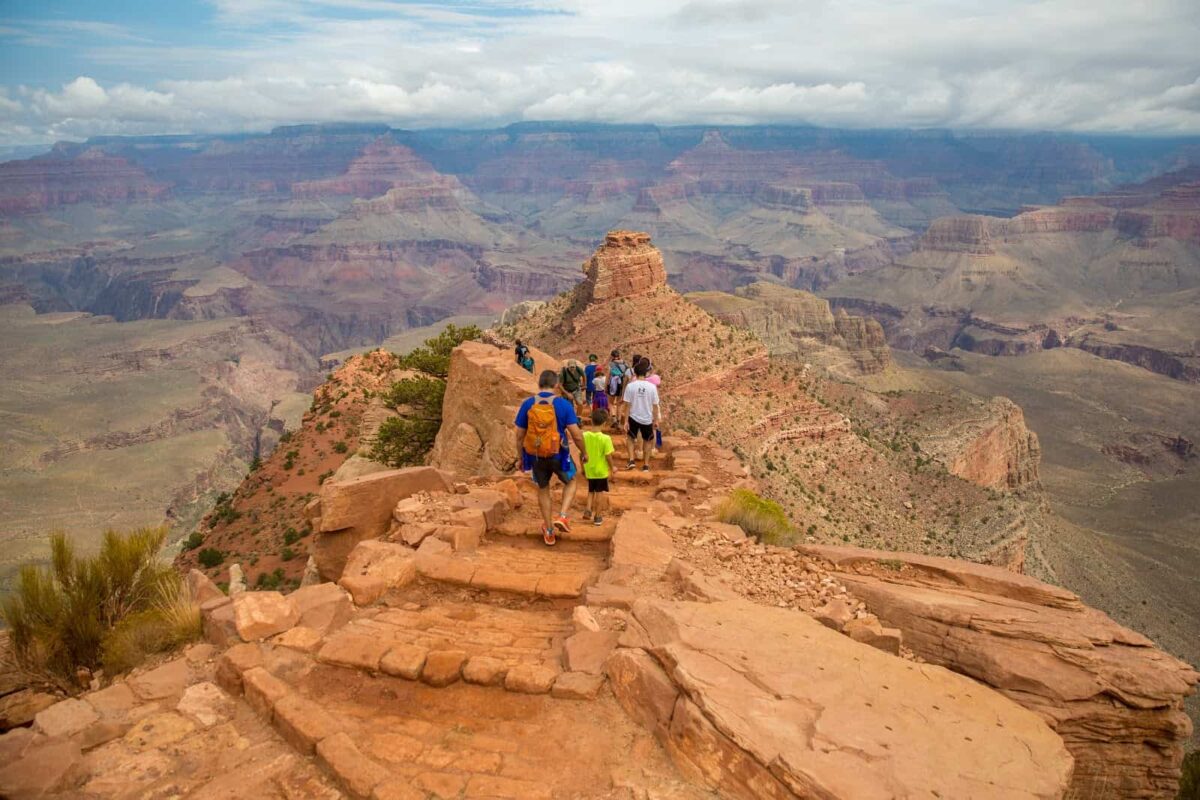
Bright Angel and South Kaibab trails are at their most pleasant during this window, and the lower angle of spring light makes the canyon walls photograph dramatically in the early morning.
May extends those conditions but adds pressure. National Park Service incident data shows that May records the highest number of heat-related hiking emergencies annually, as visitors underestimate spring temperatures that can reach 100 degrees Fahrenheit inside the canyon.
It is a counterintuitive pattern: people arrive expecting mild spring weather, hike down into conditions that feel manageable, and then face the return climb in midday heat they were not prepared for.
The principle the NPS repeats every season holds here: hiking down is optional, hiking up is not. Starting any inner-canyon hike before 8 a.m. in May is not a recommendation, it is a practical requirement.
For visitors flying in from Germany or traveling from eastern Canada, spring is also when the logistics of the broader Southwest trip align best.
For anyone combining the Grand Canyon with a Utah Mighty Five road trip covering Zion, Bryce Canyon, Capitol Reef, Arches, and Canyonlands, May offers conditions that work across all five parks without the elevation complications that colder months bring to Bryce Canyon and Capitol Reef.
Our guide to Zion National Park covers how the shuttle system and trail access there shifts in spring, which affects how you sequence the parks on a multi-stop road trip.
Summer Season
Summer is the Grand Canyon’s peak season by every measure.
July brings approximately 25,800 daily visitors, making it the busiest month of the year, with afternoon monsoon storms arriving between 11 a.m. and 6 p.m. and inner-canyon temperatures exceeding 110 degrees Fahrenheit near the Colorado River.
Parking fills before 9 a.m. at most trailheads. Shuttle queues build by mid-morning.
Lodging inside the park books out months in advance, and rates reflect the demand.
None of that means summer is a bad time to stand on the rim.
The South Rim sits at roughly 7,000 feet elevation, and daytime temperatures there hover in the mid-80s Fahrenheit in July, which is warm but entirely manageable for rim walking, shuttle touring, and ranger programs.
The problem is when visitors conflate rim conditions with inner-canyon conditions.
The NPS is explicit about this temperatures on exposed parts of inner-canyon trails can reach over 120 degrees Fahrenheit, and park rangers strongly advise against hiking in the inner canyon between 10 a.m. and 4 p.m. during summer.
Rescue operations for heat-related incidents run throughout the summer season, and the NPS warns that delays in emergency response are common when multiple rescues happen simultaneously during heat events.
For families constrained by school schedules, summer is still worth doing. Arrive early, complete any hiking before the heat peaks, stay hydrated, and treat the midday hours as rest time.
The evening light on the canyon in summer is genuinely beautiful, and the monsoon clouds that build over the canyon in August create some of the most dramatic photography conditions of the year.
Fall Season
September stands out as the overall strongest month for most visitors, offering average daytime temperatures around 75 degrees Fahrenheit, roughly 33 percent fewer visitors than peak summer, and optimal conditions for hiking, photography, and Colorado River rafting before the season closes.
October maintains those conditions and adds something else.
The North Rim’s aspen groves turn gold through October, and fall is widely regarded by both tour operators and the NPS as the best season for inner-canyon hiking and multi-day backpacking.
Viewpoints that require patience and shuttle queuing in July are accessible within minutes.
Lodging rates drop from their summer peak. The light sits lower in the sky, giving the canyon walls a depth and color that summer’s harsh overhead sun cannot match.
One planning note for October, the North Rim closes on October 15 each year when snow accumulation makes the access road impassable.
If the North Rim is on the itinerary, the first two weeks of October are the window. The South Rim operates year-round and is unaffected by this closure.
Our Grand Canyon National Park guide covers the North Rim and South Rim differences in practical detail for first-time visitors working out which side of the canyon to prioritize.
Winter Season
January records the lowest visitor counts at approximately 5,800 daily visitors, representing 77 percent fewer people than the July peak.
Weekday mornings in January deliver a canyon experience that is essentially impossible in any warmer month: viewpoints to yourself, no shuttle congestion, and the South Rim occasionally blanketed in snow that sits against the red sandstone in a way that stops people mid-sentence.
The tradeoffs are real. The North Rim is completely closed from mid-October through mid-May. Some rim-area facilities operate on reduced hours.
Hiking below the rim in winter requires gear for freezing temperatures at the top even when the inner canyon remains mild. Road conditions can deteriorate rapidly after snowfall.
For travelers from Germany and other European markets who have more flexible travel calendars and can book off-peak, the financial case for winter is significant.
Hotel rates inside and outside the park drop considerably from their summer and fall peaks.
The America the Beautiful annual pass, which covers entrance fees to all federal lands for $80, makes even more sense for a winter road trip that combines the Grand Canyon with Death Valley, which reaches its own peak season in February and March when conditions there are ideal.
The NPS publishes current conditions, trail closures, and weather alerts for the South Rim at nps.gov/grca, which is the right place to check in the weeks before any visit regardless of season.
The Grand Canyon has no genuinely bad time to visit for someone who understands what each season actually delivers.
The trips that go wrong are almost always the ones where the visitor’s expectations were built for a different month than the one they showed up in.