The best hikes in Yellowstone National Park do not require a full day, a guide, or a high fitness level.
The most searched questions about hiking here follow a predictable pattern, which trails are actually short, which ones work for families or older visitors, and whether you can see anything meaningful without committing to a backcountry push.
The answer is yes, and the options are considerably better than most trip-planning sites let on.
Yellowstone is 2.2 million acres, which tends to intimidate first-time visitors into sticking to the road. That instinct costs them.
Some of the most dramatic landscapes in the park sit within one to three miles of a parking area, and most of those trails require nothing more than a pair of decent walking shoes and a reasonable level of fitness.
The Grand Prismatic Trail
The single most rewarding short hike in Yellowstone is the one that earns you an aerial view of Grand Prismatic Spring, the largest hot spring in the United States.
The trail begins at the Fairy Falls Trailhead, located about a mile south of Midway Geyser Basin, and follows a flat old freight road for just over half a mile before a spur trail breaks left and climbs roughly 130 feet to a viewing platform overlooking Grand Prismatic and the surrounding basin.
The entire out-and-back is 1.2 miles. From ground level on the boardwalk, Grand Prismatic reads as a foggy ring of superheated water.
From above, it opens into something else entirely, a wide, sunlit circle of deep blue ringed by vivid bands of orange, yellow, and green produced by heat-loving microorganisms called thermophiles.
This is the image most people associate with Yellowstone without realizing they are looking at the view from a hill, not from a plane. To access the overlook trail, you park at the Fairy Falls Trailhead, not the Grand Prismatic parking area, a detail that catches a lot of visitors off guard.
The trail pays off most at midday when direct sunlight hits the spring and the colors are most visible, with the steam less likely to obscure the view.
Germans planning a summer itinerary moving between this park and Grand Teton would do well to spend half a day in the Midway Geyser Basin area and budget the overlook as a standalone stop rather than a quick addition to the boardwalk loop.
Mystic Falls
The Mystic Falls trail begins at the Biscuit Basin Trailhead, roughly three miles north of Old Faithful.
After crossing the Firehole River and walking a boardwalk through Biscuit Basin, which includes Sapphire Pool and Jewel Geyser, the trail breaks left into the forest along the Little Firehole River and arrives at the falls at just over a mile in.
Mystic Falls drops about 70 feet along a series of ledges. The round trip runs about 2.4 miles.
This trail is consistently underrated. Most visitors coming from Old Faithful spend their time at the geyser basin and move on without following the trail into the trees.
That’s understandable, but it means the forested section to the falls stays comparatively quiet even during peak season.
For families traveling from the American West or Canadians who have made the drive down from Alberta, this is the kind of short hike that justifies staying an extra night rather than rushing south toward Jackson Hole.
If you are still thinking through the logistics of getting there, the how to get to Yellowstone National Park guide on this site covers the driving and flight options in detail, including which gateway towns make the most sense depending on where you are coming from.
Trout Lake
The Trout Lake Loop is a 1.2-mile trail in the northeast section of the park, far from the geyser basins and Old Faithful crowds.
It begins with a short, steep climb before leveling out around the lake, where visitors can watch for river otters, waterfowl, and the occasional bear at a distance.
The northeast corner of Yellowstone is where the park earns its reputation for wildlife. The Lamar Valley, which Trout Lake sits near, is considered among the best places on the continent to see wolves in the wild.
The trailhead is not well signed along the road between the Northeast Entrance and Lamar Valley, which means many visitors zip past it entirely. That relative obscurity is an argument in its favor.
The North Rim Trail
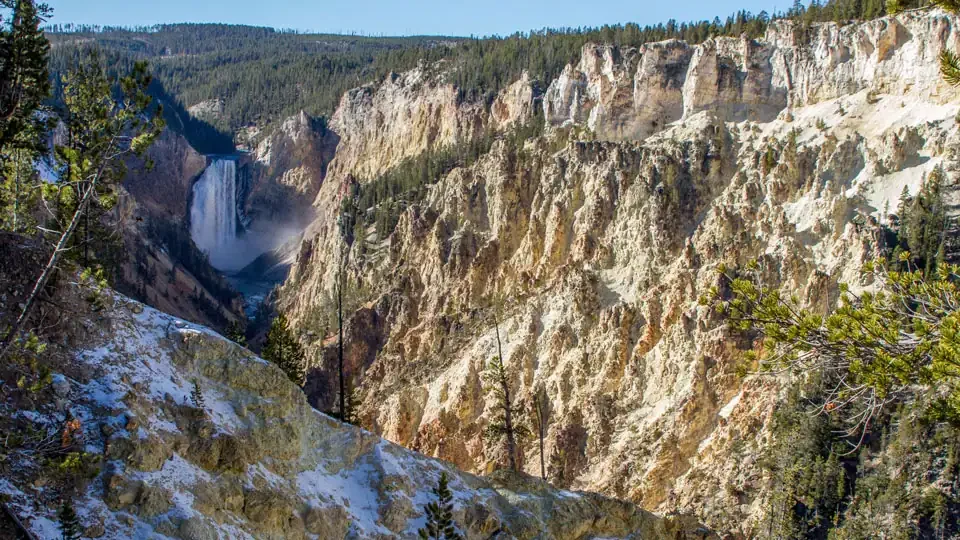
The North Rim Trail along the Grand Canyon of the Yellowstone is arguably the park’s most scenic walk, following the rim of a deep canyon with constant views including the 308-foot Lower Yellowstone Falls.
The trail is relatively flat and under five miles end to end, with various road access points that let hikers choose their own distance.
Artist Point, which sits on the South Rim, requires almost no hiking at all, a quarter-mile paved walk from the parking area to one of the most photographed viewpoints in the American West. Both give you the falls.
The North Rim gives you solitude, perspective, and a sense of scale that the overlook at Artist Point, for all its drama, cannot fully convey.
Planning Tips
Bear spray is standard equipment on any trail in Yellowstone. Starting early in the morning reduces crowds and increases the chance of seeing wildlife that moves toward cover once the day warms up.
Parking in summer can be genuinely difficult at popular trailheads, the Fairy Falls lot fills early.
The Yellowstone National Park packing list covers what to bring for day hikes, and the National Park Service’s official Yellowstone hiking page is the most reliable source for closures, seasonal restrictions, and current trail conditions.
The trails here are not technically difficult. What makes them worth the trip is everything around them, the smell of sulfur, the sound of geothermal venting, bison crossing the road without acknowledging the line of idling cars.
The best hikes in Yellowstone National Park are not consolation prizes for people who cannot manage bigger terrain. They are, in many cases, the most direct route to what this park actually is.